LinkedIn SSI: How to Improve Your Social Selling Index in 2026
LinkedIn SSI: How to Improve Your Social Selling Index in 2026
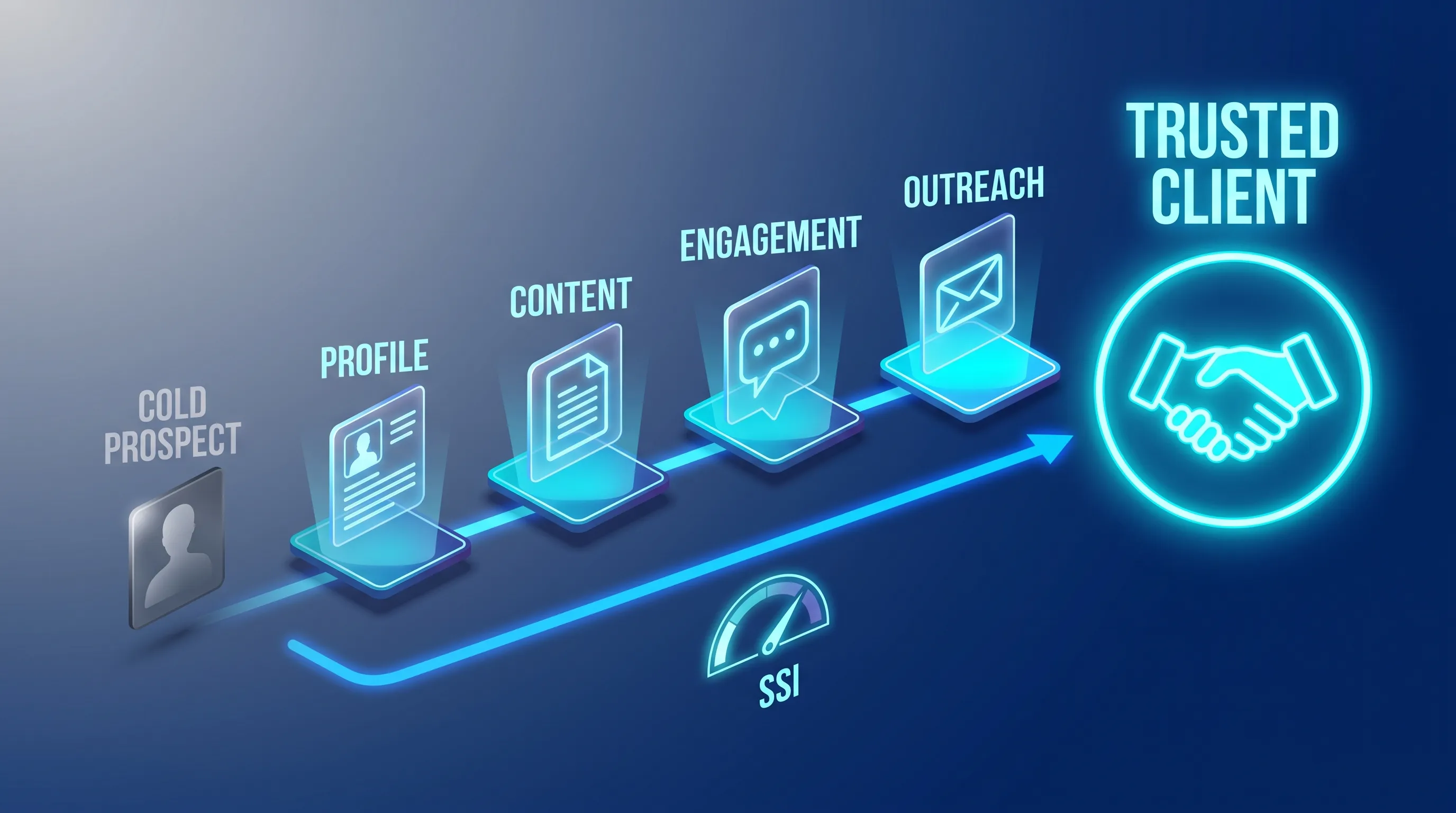
Your LinkedIn SSI is stuck around 40, while two direct competitors show 70 or more on the same ranking page. That number does not measure your sales talent: it measures a specific activity, split across four pillars, and each one can be improved with concrete actions.
In this guide: what the SSI (Social Selling Index) really measures, how to check it, the benchmarks by role in 2026, and the pillar-by-pillar method to raise it without falling into the bad habits that drag it down.
Why the SSI matters for freelancers and founders too
The SSI was designed for sales teams, but what it measures (a clear profile, a relevant network, regular content, sustained relationships) applies just as much to a freelance consultant or a startup founder looking for clients without a sales team behind them.
Take a recruitment consultant starting her business. Her SSI caps at 35 in the first months: incomplete profile, generic network, no posts. Within three months, she completes her profile, focuses her connections on HR decision-makers in her niche, and posts twice a week about her client cases. Her score climbs toward 60, and with it come direct messages from prospects who saw her posts before she even contacted them. The score did not produce anything on its own: it simply followed actions that do generate opportunities.
What is the LinkedIn SSI
The Social Selling Index, or SSI, is a score out of 100 that LinkedIn calculates automatically from your activity on the platform. It assesses your ability to use LinkedIn as a sales tool, not your follower count or how long you have been on the network.
The score is recalculated every 24 hours, based on the previous day's activity and the last thirty days. It is available for free to anyone with a LinkedIn account, without Sales Navigator, on the official Social Selling Index page.
0 to 100
SSI score range
25 pts
per pillar, across 4 pillars
+45%
more opportunities for top scores, according to LinkedIn
The 4 pillars that make up the SSI score
Each pillar is scored out of 25 points. Their sum gives your overall SSI, shown as a chart on your score page.
- Establish your professional brand: a complete profile, a polished photo and banner, a clear headline, recommendations. This is the discovery phase, the one that builds trust before any exchange.
- Find the right people: the relevance of your network matters more than its size. This pillar assesses your ability to identify and reach the right profiles, not to pile up connections.
- Engage with insights: the consistency and value of your posts, comments and shares. This is the pillar closest to content creation in the broad sense.
- Build relationships: the quality of your outreach and how you follow up conversations with prospects or decision-makers, beyond simply connecting.
How to check your SSI score
Log in to LinkedIn
Open your usual LinkedIn account, the one you use to post and interact. You do not need a Sales Navigator account to see your score.
Open the dedicated page
Go to linkedin.com/sales/ssi. The page shows your overall score, its recent trend and the breakdown by pillar.
Read the pillar breakdown
Look at the four scores out of 25 points and your ranking in your industry and within your network. This breakdown, more than the total, shows where to act first.
What is a good SSI score in 2026
There is no universal threshold: the average score varies by role and by how intensively LinkedIn is expected to be used. The following benchmarks, compiled by Ligo Social, give an order of magnitude to see where you stand in 2026.
| Role | Good score | Excellent score |
|---|---|---|
| SDR / BDR | 60 to 70 | 75 and above |
| Account Executive | 65 to 75 | 80 and above |
| Sales leader / VP Sales | 70 to 80 | 85 and above |
| Recruiter | 75 to 85 | 90 and above |
These benchmarks are indicative. A freelance consultant who rarely prospects by direct message but posts a lot may well show high scores on the brand and content pillars while staying lower on the relationships pillar, without that signaling a sales problem.
How to improve each SSI pillar
Professional brand
Complete every section of your profile: summary, detailed experience, skills, education. Add a sharp photo and a custom banner, write a headline that says what you bring rather than a generic job title, and ask recent clients or colleagues for recommendations.
Finding the right people
Use LinkedIn search to target relevant profiles rather than accepting every incoming request. Send invitations with a personalized note that mentions a real point in common (a post, a company, a shared group), aiming for a high acceptance rate rather than a high volume.
A network of 500 connections focused on your industry weighs more on this pillar than a network of 5,000 contacts unrelated to your business. Clean up occasionally, too: an invitation left pending for months helps neither your score nor your results.
Engaging with insights
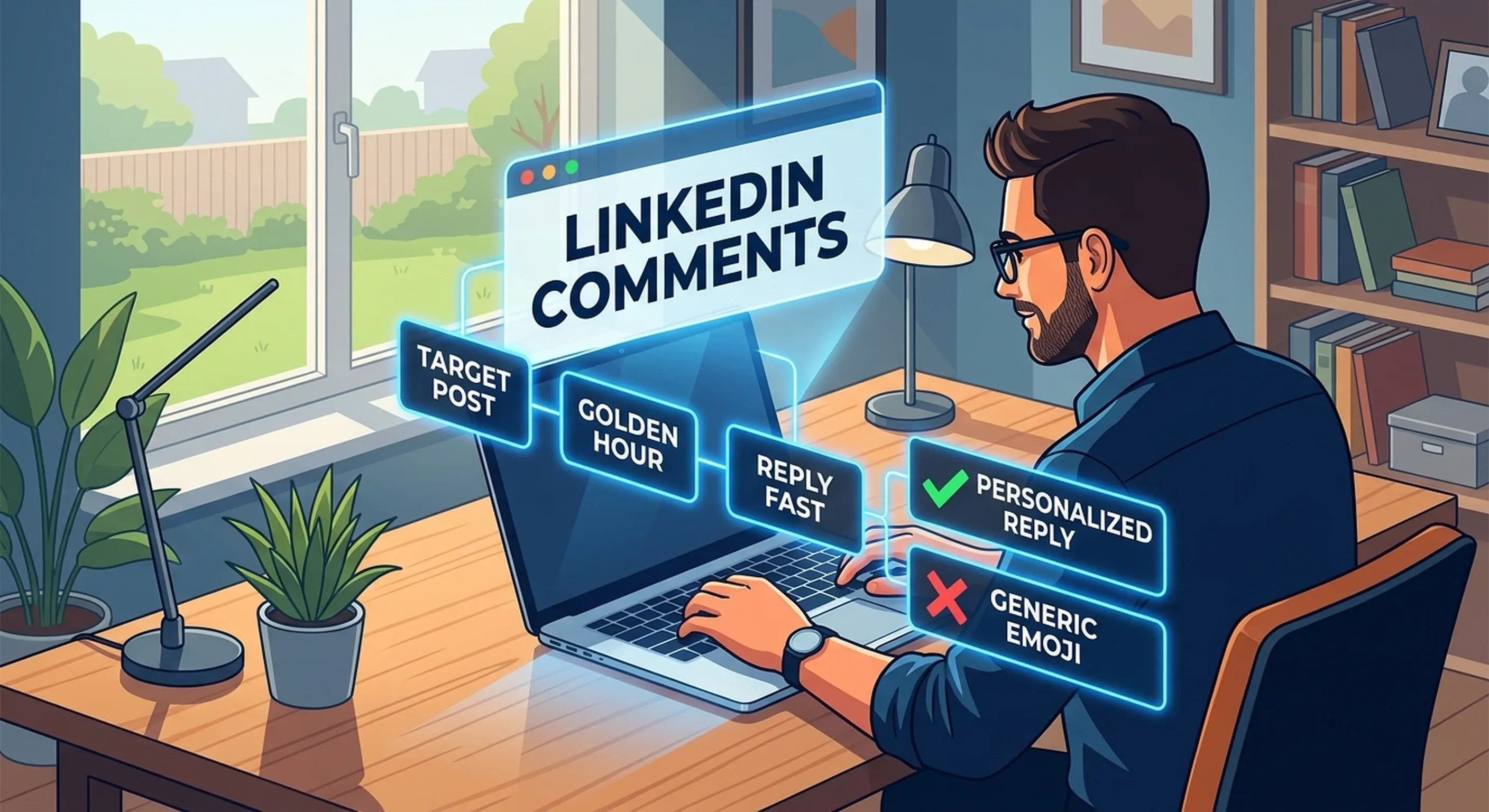
This pillar is the most closely tied to posting consistency. Share analyses of your industry, comment on your network's posts with a real point of view, and vary formats (text, carousel, video) to reach different segments of your audience. Well-organized industry monitoring makes this consistency easier: you never start from scratch for each post.
To go further on this specific pillar, our guide to the LinkedIn social selling method explains how to turn these posts into sales conversations.
Building relationships
Start private conversations from a real hook: a shared post, news about the prospect's company, a question asked in the comments. Keep these exchanges going over time instead of leaving them unanswered after the first message.
Three or four meaningful conversations a week, followed up at the right moment, weigh more on this pillar (and on your real results) than a dozen prospecting messages sent in a burst and never followed up.
Mistakes that drag down your SSI score
Avoid these if you want to progress
- Sending invitations in bulk, without a personalized note.
- Leaving connections dormant without ever interacting with them.
- Posting hollow comments ("Great post!") to fake activity.
- Reposting copied or generic content that engages no one.
- Focusing on a single pillar while ignoring the other three.
SSI and sales performance: the limits of the score
LinkedIn states that profiles with the highest scores generate more opportunities than those with low scores, but that figure remains a platform claim, not audited by an independent third party. The SSI is still useful as a LinkedIn hygiene indicator: it tells you whether you use the platform's four levers properly, not whether your efforts turn into meetings or revenue.
To track what really happens behind the score, cross-check it with your own post analytics. Your Suma AI analytics dashboard brings the tracking of your posts over time into one place, and lets you see which content actually drives profile views and conversations.
In the same way, a poorly filled-in profile drags down the brand pillar before you even think about content. Our guide on how to optimize your LinkedIn profile to attract clients covers this first pillar in detail.
Yes. The score is visible for free at linkedin.com/sales/ssi with a standard LinkedIn account. Sales Navigator gives access to extra tools to progress, but it is not required to check your score.
Key takeaways
Your LinkedIn SSI is not a number to watch passively: it is a four-part diagnosis that shows exactly where to focus your efforts. Complete your profile, target your connections, post consistently and follow up your conversations over time, and the score will follow.
Want to feed the content pillar without giving up your evenings?