How to Turn LinkedIn Followers Into Clients: The Method
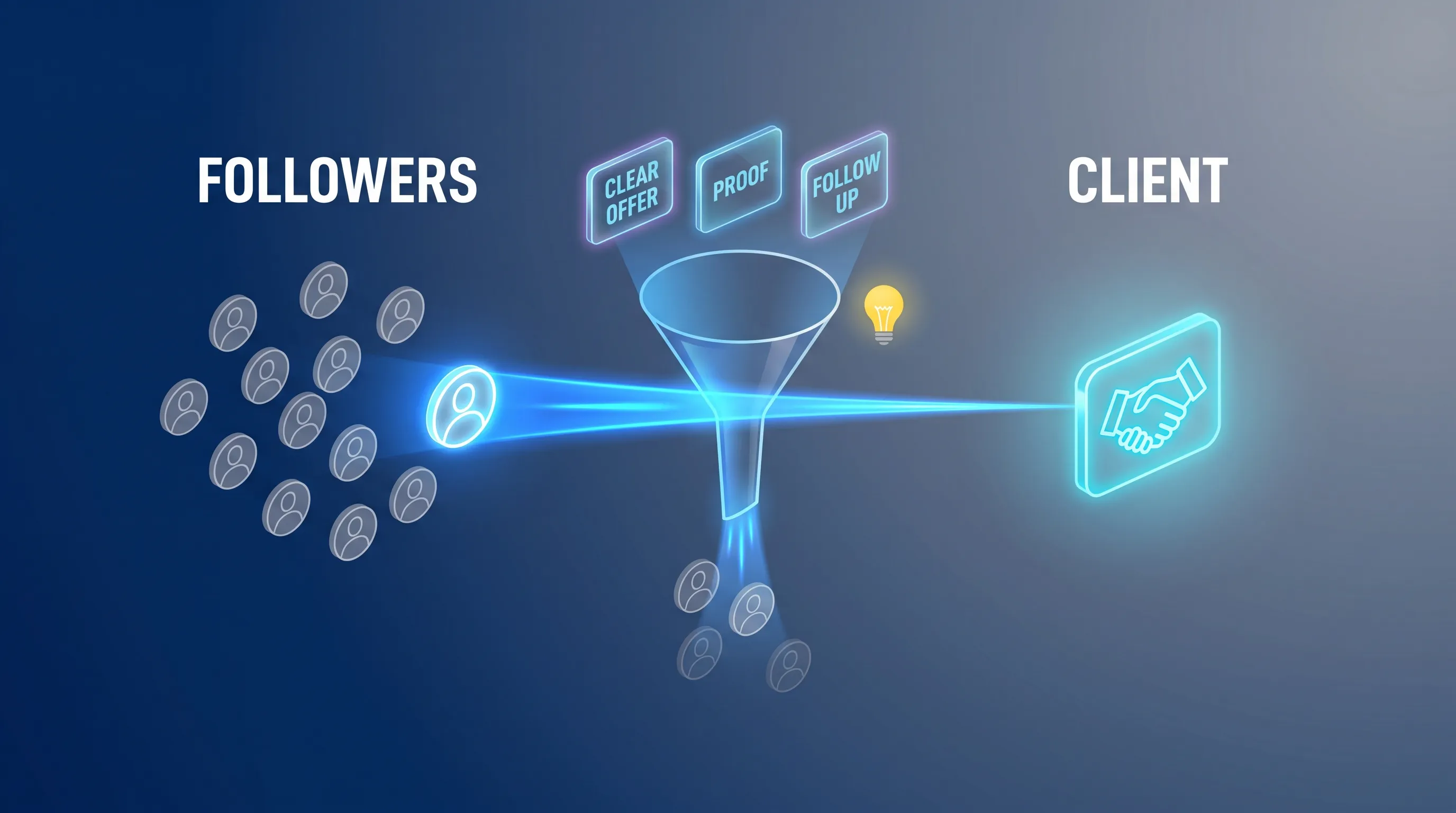
You have followers who like and comment on your LinkedIn posts, but they never become clients. It is one of the most common traps in personal branding: confusing visibility with buying intent, and waiting for clients to show up on their own because the audience is growing. Turning LinkedIn followers into clients takes a precise mechanism, not a bigger audience.
Here is the five-step method to build that bridge between your content and your sales, without spamming your followers or distorting your editorial line.
Why don't your followers become clients?
Because a like or a comment is not a buying decision. Your followers find you competent, but nothing in your content tells them what to do next, who to talk to, or why now. Without an explicit bridge between what you publish and what you sell, your audience stays a spectator.
Three causes come up in most of the profiles we see. First, the profile is not designed as a storefront: nothing says concretely what you sell or to whom. Second, the content informs without ever guiding: no call to action at all, or a generic CTA buried at the end of the post. Third, there is no path from public to private: a follower who wants to know more has no simple way to do so without feeling intrusive.
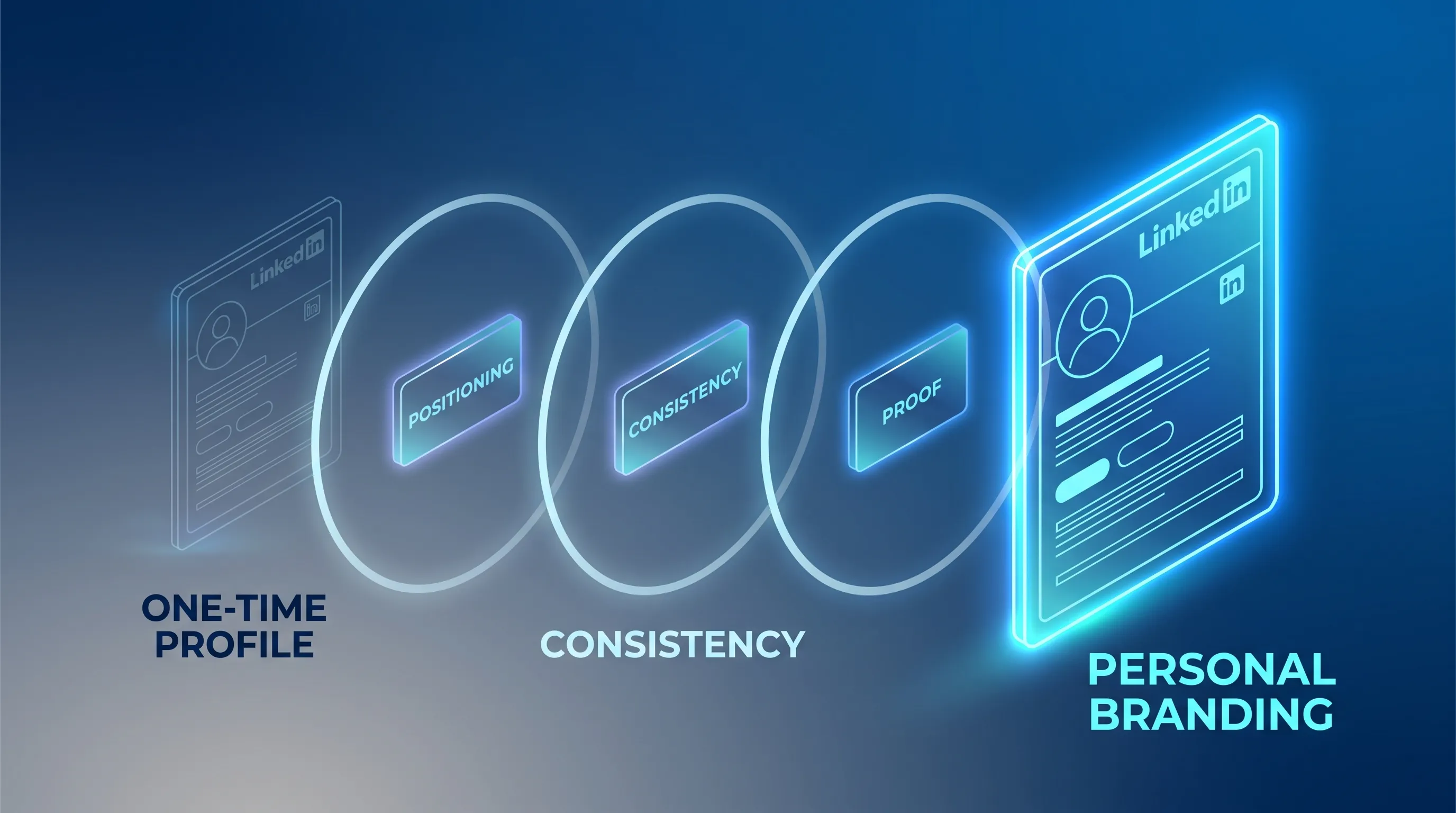
If your LinkedIn profile still reads like a resume rather than a sales page, that is often the first weak link to fix before even thinking about conversion.
The 5-step method to turn followers into clients
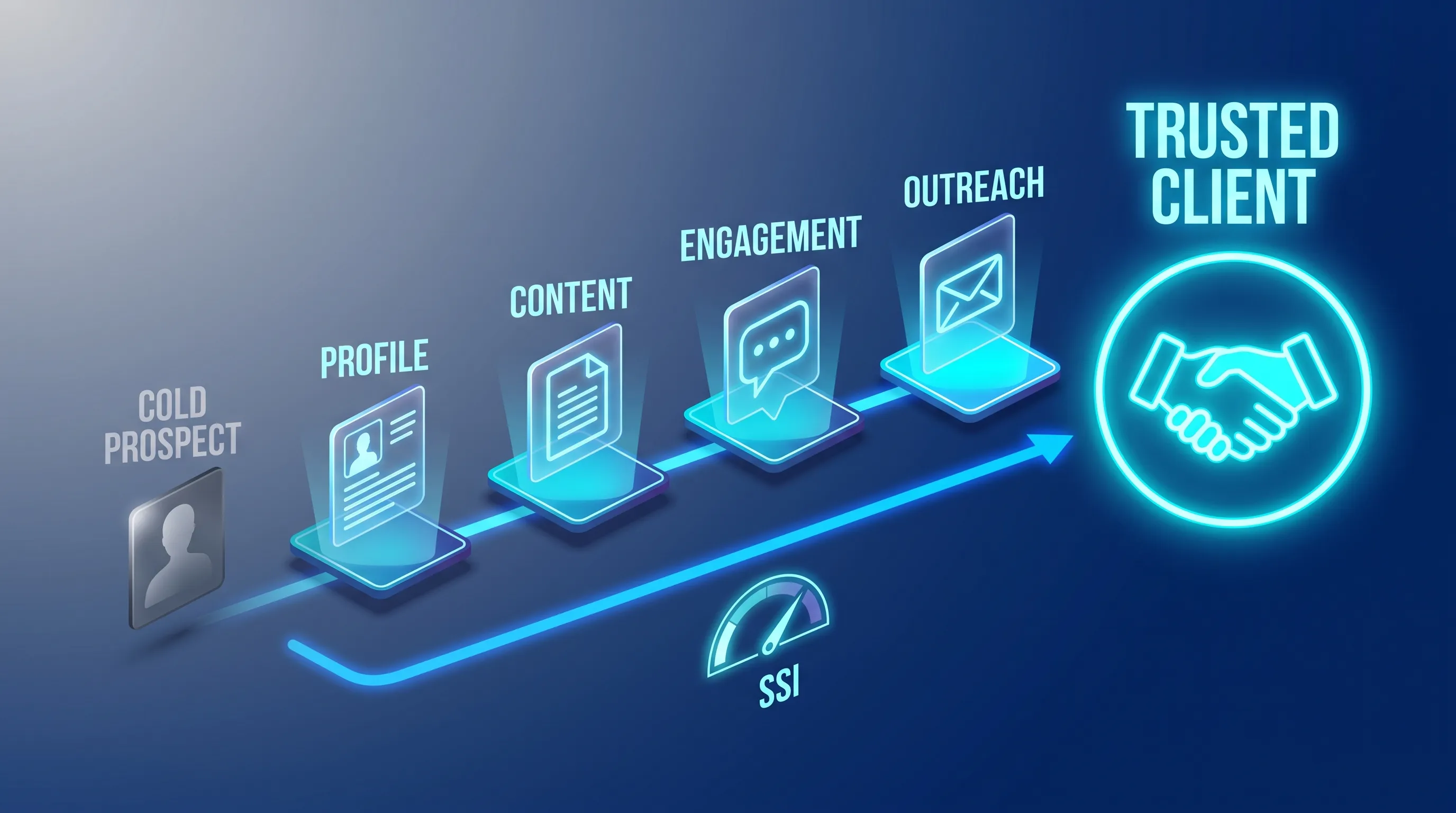
Each step fixes a specific friction point. Order matters: skipping a step means selling to people who have no reason to trust you yet.
Give a concrete reason to take action
A follower reading a useful post has no reason to click if there is nothing to click. Offer a short, specific resource: a checklist, a template, a quick 10-minute audit. The goal is not to capture an email at all costs, but to offer a simple first step that proves your expertise before the sale. An HR consultant who offers an interview scorecard in the comments gets more inbound contacts than a plain "learn more" at the end of a post.
Build an explicit bridge between content and offer
Roughly one post in three can end with a precise question or invitation, never a generic one. "Tell me in the comments your biggest blocker on this topic" works better than "what do you think?", because the follower's answer gives you usable information for the rest of the conversation. That bridge, repeated consistently, is what turns useful content into a sales starting point.
Move the conversation from public to private
Conversion rarely happens in the comments. As soon as a follower shows a real signal (a specific question, a situation that looks like your clients', a share), move the exchange to a direct message with a sentence that picks up on what they said, not a copy-pasted outreach script. That is the logic of social selling: you do not sell in the public discussion, you use it to spot who has a real pain to solve.
Show proof before you sell
A follower hesitating between you and a competitor is looking for proof, not one more argument. Regularly share concrete results achieved for a client (anonymized if needed), before and after comparisons, or real quotes from client feedback. Social proof reassures more than yet another theoretical post about your expertise.
Follow up without pushing
Most conversions happen after several touchpoints, not at the first message. Keep a simple list (even a spreadsheet) of followers who have shown interest, and get back to them when you publish content that answers exactly what they mentioned. A contextual follow-up, tied to a past conversation, never feels like cold outreach.
How long does it take to turn a follower into a client?
Expect several weeks to several months depending on your industry and the price of your offer: a follower rarely follows a linear path, they watch, compare, then act when the need becomes concrete. Posting consistently shortens that delay by keeping your offer top of mind at the right moment, without ever replacing the proof and follow-up work described above.
The right reflex in the comments
Do not reply to every comment the same way. A polite comment ("thanks for this post") deserves a like and a short reply. A comment that describes a real situation ("I'm dealing with exactly this problem") deserves a follow-up question in public, then a direct message if the exchange continues.
Keeping up that consistency without giving up your evenings is often the real obstacle. That is exactly what Suma AI does: it monitors your industry and generates structured posts in your style from the trends it spots, so the conversation with your followers never stops for lack of time.
Should you generate new leads or convert existing followers?
The two are complementary, not interchangeable. Generating leads on LinkedIn means widening your audience with new people who do not know you yet. Converting your followers means activating an audience you already have, one that often knows you better than a cold prospect. Neglecting conversion to chase new followers is like filling a leaking bucket.
Frequently asked questions
There is no fixed number: it depends on the price of your offer and the level of trust needed to buy it. What matters more than the number of posts is consistency and a clear bridge between your content and your offer at every relevant opportunity.
Key takeaways
Turning LinkedIn followers into clients has nothing to do with the size of your audience. It is a five-step mechanism: give a reason to act, build a bridge to your offer, move to private at the right moment, prove before you sell, and follow up without pushing. Applied consistently, this method turns an audience that likes you into clients who trust you.