360Brew Explained: How LinkedIn's New Algorithm Works
360Brew Explained: How LinkedIn's New Algorithm Works
Your LinkedIn reach has dropped, and every article you read blames the same culprit: 360Brew, the AI that supposedly replaced the platform's algorithm. The name is everywhere and so is the certainty, but few people have read the sources. This article separates what LinkedIn has actually published from what practitioners infer from it.
Here is what's inside: what 360Brew is, what is established and what is not, what the model can read in your profile, and a 5-step method to publish consistently without chasing every rumor.
What is 360Brew?
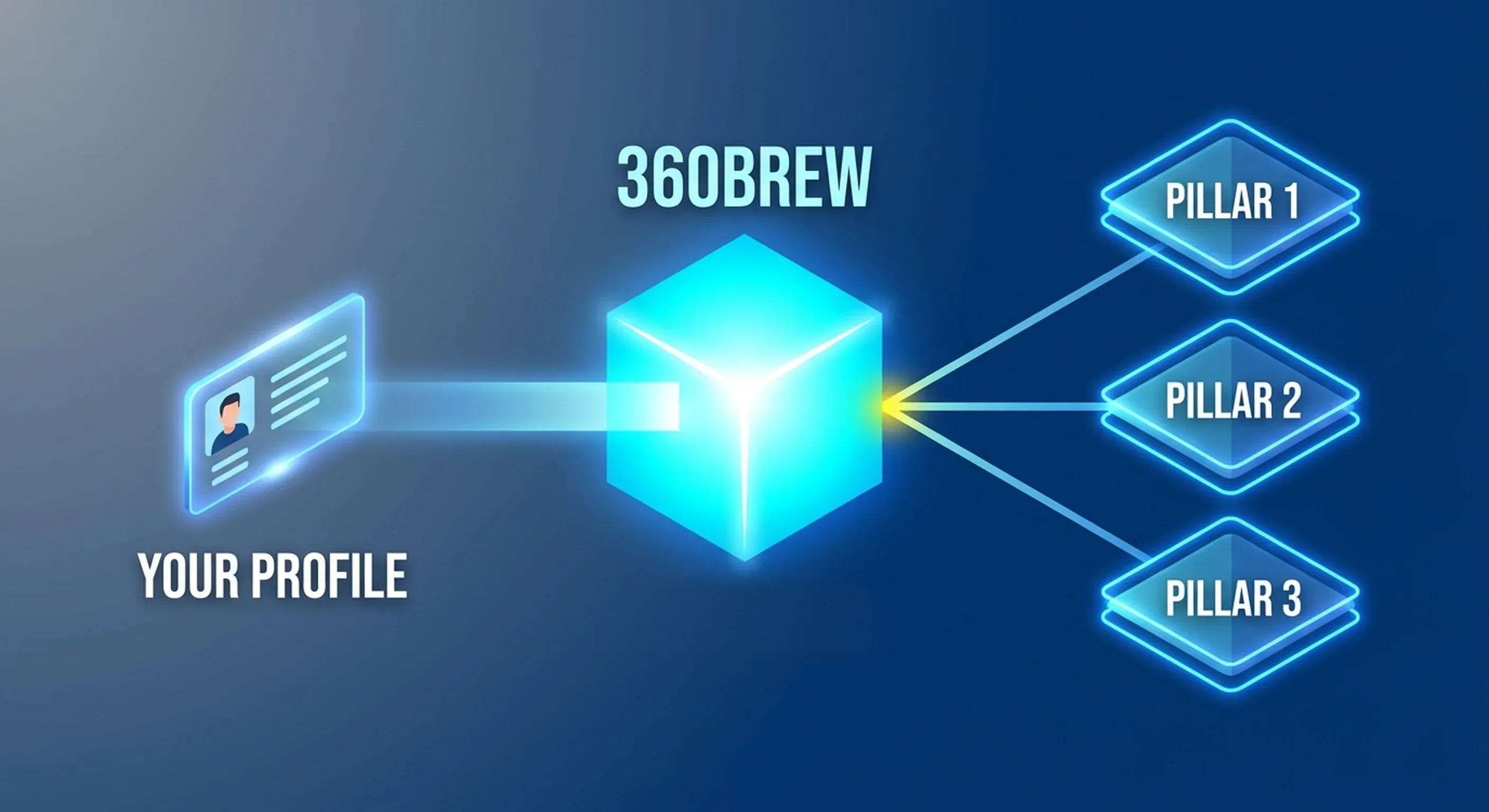
360Brew is a 150-billion-parameter language model built by LinkedIn's Foundation AI team. Rather than computing a score from many separate signals, it receives text descriptions of your profile, your activity and a piece of content, then predicts whether a given person will find it relevant.
The source is a research paper published on arXiv in January 2025. It presents a single model able to handle more than 30 recommendation and ranking tasks across the platform, where each task previously needed its own model maintained by a dedicated team. The core idea: turn member behavior into text and hand it to a general-purpose model, instead of stacking rules.
In plain terms, LinkedIn is trying to understand what a post is about, who wrote it and who it could help, without giving up engagement signals, which are still fed to the model.
What LinkedIn has confirmed, and what is interpretation
Two texts matter. The January 2025 research paper, and an engineering blog post from LinkedIn published on March 12, 2026, describing the rebuild of the feed. According to the detailed write-up by PPC Land, LinkedIn explains that it replaced several independent content sources with a single LLM-based retrieval system, then ranks posts with a sequential model that takes into account more than 1,000 of the member's past interactions.
This table helps sort the facts from the guesses.
| Topic | What is established | What is interpretation |
|---|---|---|
| The 360Brew model | A research paper by LinkedIn's teams describes it as a "pre-production" model, trained on data from members outside the European Union | Nothing to add, the source is public |
| An LLM-powered feed | In March 2026, LinkedIn described a new LLM-based system for retrieving and ranking feed content | That this system is exactly 360Brew: as far as we know, LinkedIn has not officially used that name for it |
| What the model reads | For a post: author headline, company, industry, text, engagement volume. For a reader: work history, skills, education, posts already viewed | How much each element weighs has not been published |
| Effect on reach | No official figure on creators' reach | The reported reach drops come from practitioner analyses |
Why be cautious
The March 2026 post describes an architecture and modeling results, not signal weights: going by the write-ups, it does not give the weight of comments, saves or dwell time. The French trade outlet La Réclame (in French) already noted in November 2025 that LinkedIn had shared nothing on measured effects, or on the balance between interest, engagement and monetization. Treat the advice you read as field hypotheses, to be checked on your own account.
Why your reach dropped
Richard van der Blom's Algorithm Insights report, relayed by Dataslayer, reports a drop of about 50% in views, 25% in engagement and 59% in follower growth over one year. These are practitioner measurements, not LinkedIn figures, and they do not prove that the feed rebuild is the cause.
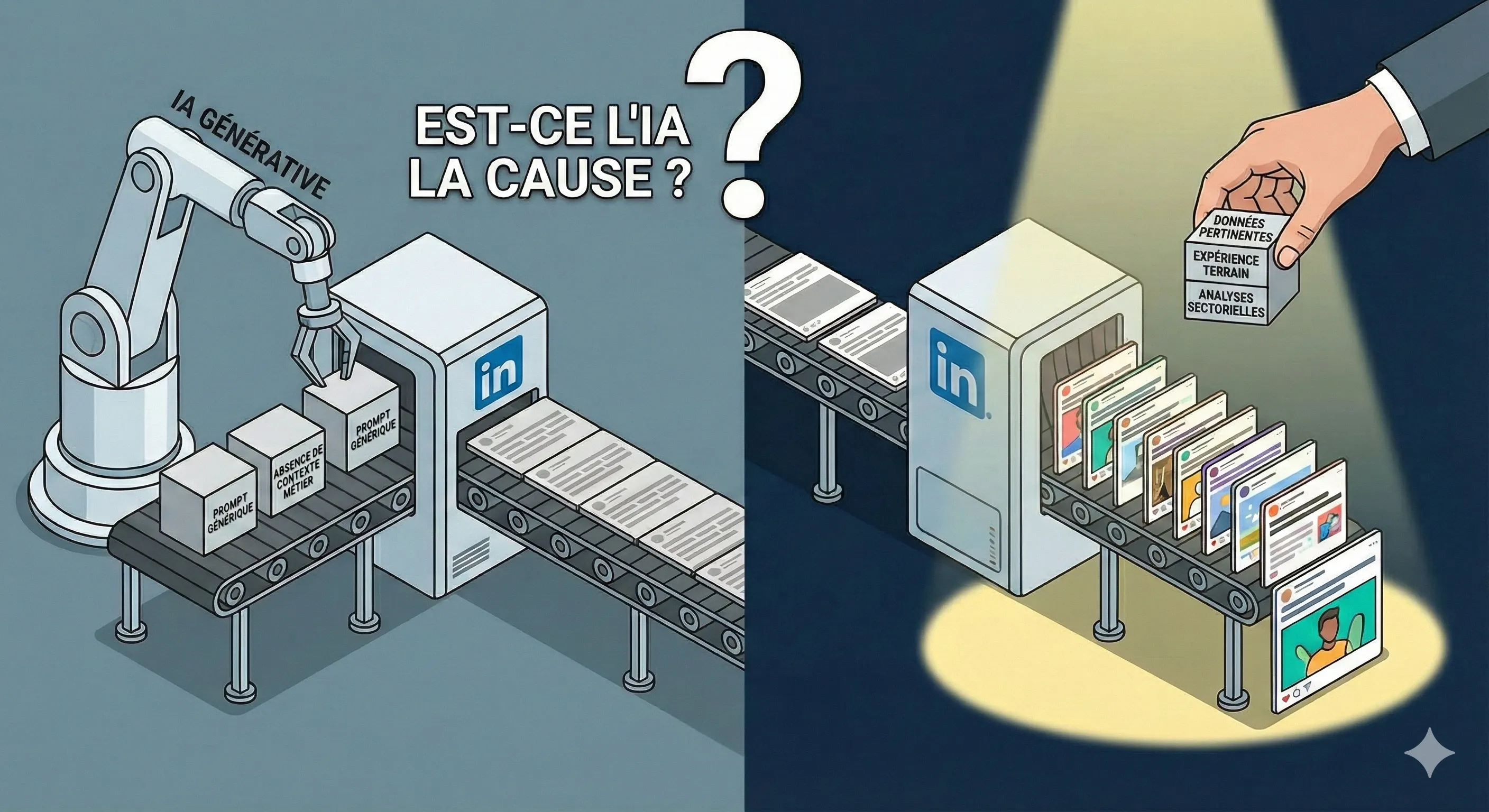
Two other explanations are plausible: the wave of generated posts that all sound the same (we cover it in why your AI posts all look the same) and the declining value of artificial engagement tactics.
The good news is that whatever the cause, analyses converge on the same levers: topical consistency, substantive conversations, and content people keep for later. Chris Donnelly, quoted by Forbes in January 2026, ranks saves among the most decisive signals for a long time now. For the fundamentals (formats, frequency, structure), the complete guide to LinkedIn content in 2026 remains the reference.
What 360Brew can read in your profile
It is documented, not just assumed: according to the March 2026 post, the model receives, for each post, the author's headline, company and industry, on top of the text. For the reader, it also receives their work history, skills, education and the sequence of posts they have already viewed. Your headline and your posts are therefore read, and matched with an audience that has already shown interest in your topics.
What remains a hypothesis is how much each element weighs, and the role of your About section, which the write-ups do not mention. Several practitioners, including Falia, talk about a "semantic fingerprint": everything your profile and your posts say about you.
A 5-minute DIY test
Paste your headline, your About section and your last 10 posts into an AI assistant, then ask which 3 areas of expertise it sees. If its answer does not match what you want to stand for, the gap exists for a model that reads you too. This test does not simulate 360Brew: it simply reveals an inconsistency between what you say you are and what you publish.
How to build 3 consistent content pillars
Practitioner analyses give the same instruction: post regularly on 2 to 4 precise topics rather than on everything. Three pillars are a good compromise, broad enough not to burn out, narrow enough to be recognizable.
Write your promise in one sentence
For whom, which problem, which result. For example, a CFO at a company of 50 to 200 people who wants to be known for making cash-flow forecasts reliable.
Pick your 3 pillars
Each pillar pairs a topic with an angle. For that CFO: cash-flow forecasting, planning tools, and the reporting mistakes they fixed on the job.
Align your profile with those pillars
Reuse the vocabulary of your pillars in your headline and your About section. Describe the problems you solve and who they concern, rather than a list of keywords.
Feed each pillar with monitoring
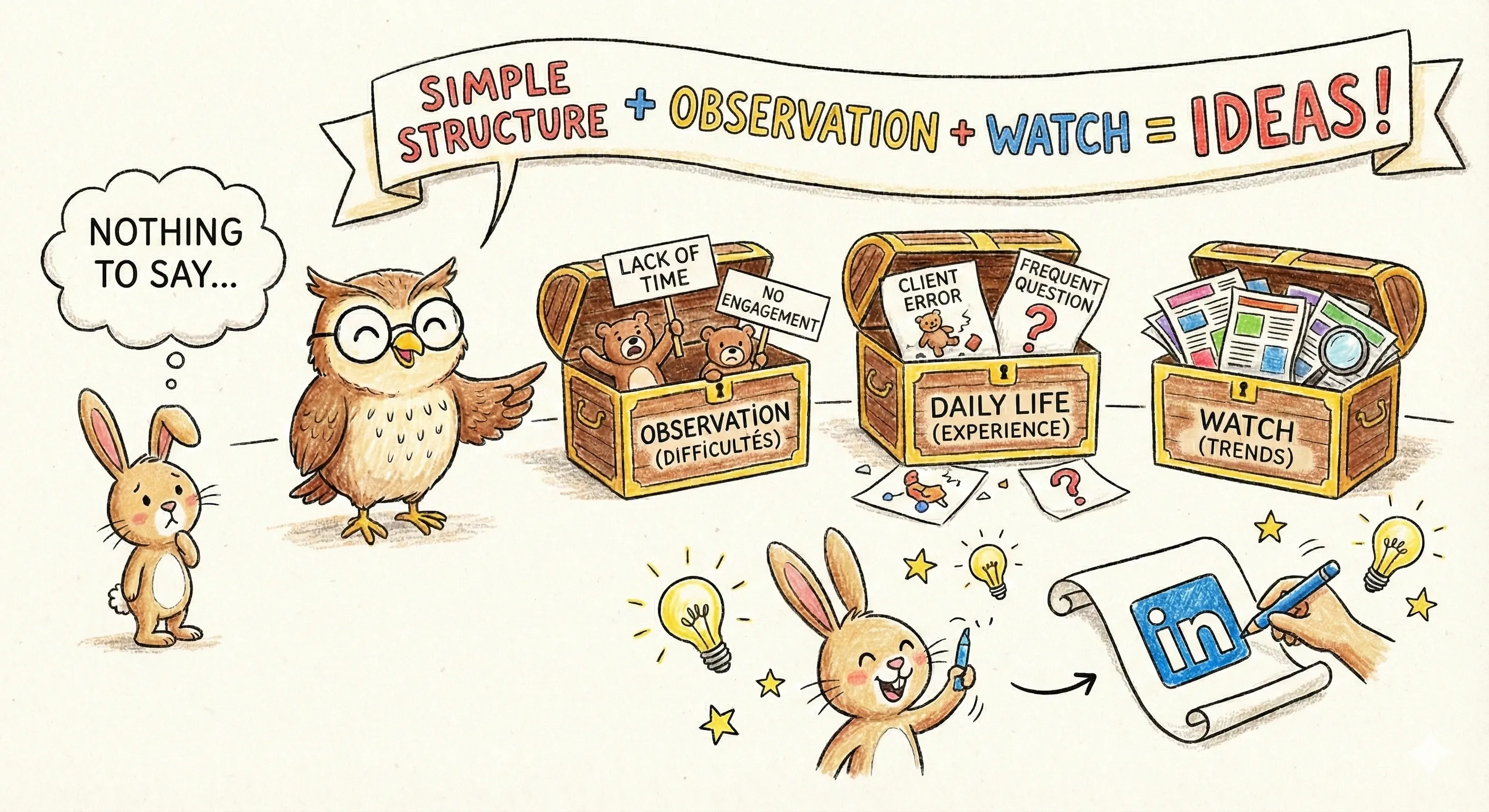
Choose 2 to 3 sources per pillar (blogs, YouTube channels, LinkedIn accounts) so you always have news to react to. If inspiration still runs dry, our method to find a LinkedIn post idea steps in.
Publish, then measure over 6 to 8 weeks
Every post brings an experience or a data point that belongs to you. Then compare thoughtful comments and saves, not just likes, before changing your pillars.
What no longer works (or barely)
- Hashtags at the bottom of a post. According to Chris Donnelly, the algorithm now classifies a post by its text: better to put your topic's vocabulary inside your sentences.
- Generic comments like "Thanks for sharing", and engagement pods. Practitioners agree that these signals have lost their value.
- Posting on everything. Seven topics in a week is an unreadable semantic fingerprint for a model as much as for your audience.
Beware of magic recipes
Nobody outside LinkedIn knows the real weighting of signals. Any method promising "x times more reach thanks to 360Brew" sells a hypothesis as a fact. Test on your own account, over several weeks, and keep what works for your audience.
Frequently asked questions
360Brew is a 150-billion-parameter language model described by LinkedIn's teams in a research paper from January 2025. It is used to rank and recommend content, jobs or connections by reading text descriptions of members, instead of combining many specialized models.
Key takeaways
The rebuild of LinkedIn's feed around language models is confirmed by LinkedIn. The rest, meaning signal weights and the recipes going around, is mostly field observation. What you can do right now: a readable profile, 3 pillars kept up over time, posts that bring something. None of it depends on a hack, and it stays useful if the algorithm changes again. Suma AI helps you stay consistent and keep your voice, but no tool can promise to please 360Brew.