The Complete Guide to LinkedIn Content in 2026
The Complete Guide to LinkedIn Content in 2026
LinkedIn has changed. The LinkedIn post format you relied on in 2022 no longer works the same way. The algorithm has evolved, reading habits have shifted, and the competition for attention has intensified. This guide brings together everything you need to know to create LinkedIn content that drives visibility, engagement, and real opportunities in 2026 — whether you're an employee, entrepreneur, consultant, or in a career transition.
You'll find here: the formats that work, how to structure your posts, how often to publish, what to write when you have no ideas, and how the algorithm decides to distribute (or bury) your content.
What LinkedIn Has Become in 2026
LinkedIn is no longer just an online résumé. It has become the go-to network for professionals who want to build an audience, share expertise, and generate leads — without an ad budget.
With over a billion members worldwide and consistent growth in the number of content creators, the platform is more active than ever. But this activity has a downside: it's increasingly hard to stand out if you're posting without a strategy.
What LinkedIn Favors Today
The 2026 algorithm rewards three things:
- Relevance to the reader's network (your post should interest the connections of your connections)
- Early engagement (reactions and comments in the first hour are decisive)
- Consistency and thematic coherence (posting regularly on the same topic positions you as an expert in the algorithm's eyes)
Reach is no longer the primary metric — depth of engagement is. A post that generates 15 quality comments will be distributed better than one that gets 200 passive likes.
The LinkedIn Content Creator in 2026
The profile of a successful LinkedIn creator today isn't necessarily the most popular one. It's someone who:
- Chooses a clear editorial territory (1 to 3 topics maximum)
- Publishes with a recognizable and consistent voice
- Systematically replies to comments
- Adapts formats to the type of message they want to convey
This guide shows you exactly how to do that.
LinkedIn Post Formats That Work in 2026
Choosing the right LinkedIn post format is the most structural decision you make before writing. The format determines reach, the type of engagement, and the message you can convey.
Short Text Post (150–300 words)
This is the most underrated format. A short, well-crafted text with a strong hook and a single central idea can generate disproportionate engagement. Why? Because people read it in full. And LinkedIn rewards reading time.
Recommended structure:
- Line 1: hook (question, counterintuitive statement, number)
- Body: 2–3 short paragraphs, one idea per paragraph
- Closing: a strong question or point of view that invites reaction
This format is ideal for sharing an opinion, a lesson from experience, or a professional observation.
Long Text Post (500–1,300 words)
Long-form works on LinkedIn — if it's well-paced. The classic mistake: a wall of text with no breathing room. On mobile (70% of LinkedIn reads), a 5-line paragraph is already too long.
For an effective long text post:
- Each paragraph = 1 to 3 lines maximum
- Use bullet lists sparingly (no more than 5–7 items)
- Place "micro-hooks" every 3–4 paragraphs to retain the reader
This format suits storytelling, detailed experience-sharing, and trend analysis.
The Carousel (PDF Document)
The carousel format remains one of the most powerful in 2026. It generates high impressions because each slide swipe counts as an interaction. And it drives saves — the strongest signal you can send to the algorithm.
For a converting carousel:
- Slide 1: strong promise, visually impactful (this is your hook)
- Slides 2–8: one idea per slide, simple and readable visuals
- Last slide: clear CTA (follow, comment, DM)
Keep it to 8–12 slides. Beyond that, you lose readers.
For more on post structure, read The Ideal Structure of a LinkedIn Post in 2026.
Native Video
Native video (uploaded directly to LinkedIn, not a YouTube link) gets an algorithmic boost. In 2026, LinkedIn particularly promotes short videos (30–90 seconds) in a vertical mobile format.
Note: video only works if sound is optional. Most views happen without sound — always subtitle your videos.
Image Post or Infographic
A post with a custom image (not a generic stock photo) performs well if the image carries information on its own. Infographics that are readable directly in the feed — without clicking — are particularly effective.
Avoid decorative images: they add no value and don't improve reach.
Poll
The poll is the format with the easiest engagement to trigger. But a poll without follow-up (results post, comment replies) is a missed opportunity. Use it to start a conversation, not just to collect votes.
How to Structure an Effective LinkedIn Post
Regardless of the format, an effective LinkedIn post rests on three pillars: the hook, the body, the close.
The Hook: The First 2 Lines Are Everything
On LinkedIn, only the first two lines are visible before "see more." If they don't capture attention, nobody reads the rest. It's that simple.
A good hook must do one of the following:
- Create tension ("I made a mistake that cost me a client")
- Ask a relevant question ("Have you been posting on LinkedIn for 6 months with no results?")
- State a counterintuitive claim ("Posting every day hurts your visibility")
- Announce a value promise ("Here are the 5 formats generating the most engagement in 2026")
What to avoid: starting with "I" or your name, beginning with unnecessary context, or stating an obvious truth.
The Body: One Idea, One Progression
Each section of your post body should move the reader toward resolving the problem raised in the hook. Cut everything that doesn't serve that progression.
If you list points, make sure each one is actionable or illustrated with a concrete example. Generalities — "be authentic," "create value" — are the poison of LinkedIn content.
The Close: Don't End in a Void
Posts that end abruptly lose their engagement potential. Your close should:
- Ask an open question that invites comments
- State a strong, slightly polarizing point of view (without being controversial)
- Give a clear, friendly instruction ("Save this post if you want to come back to it")
Avoid the classic "What do you think?" alone — it's too lazy. Reframe the question with your own view included.
LinkedIn Publishing Frequency
How often should you publish per week to maximize visibility without burning out? It's one of the most frequently asked — and poorly answered — questions.
What the Data Says in 2026
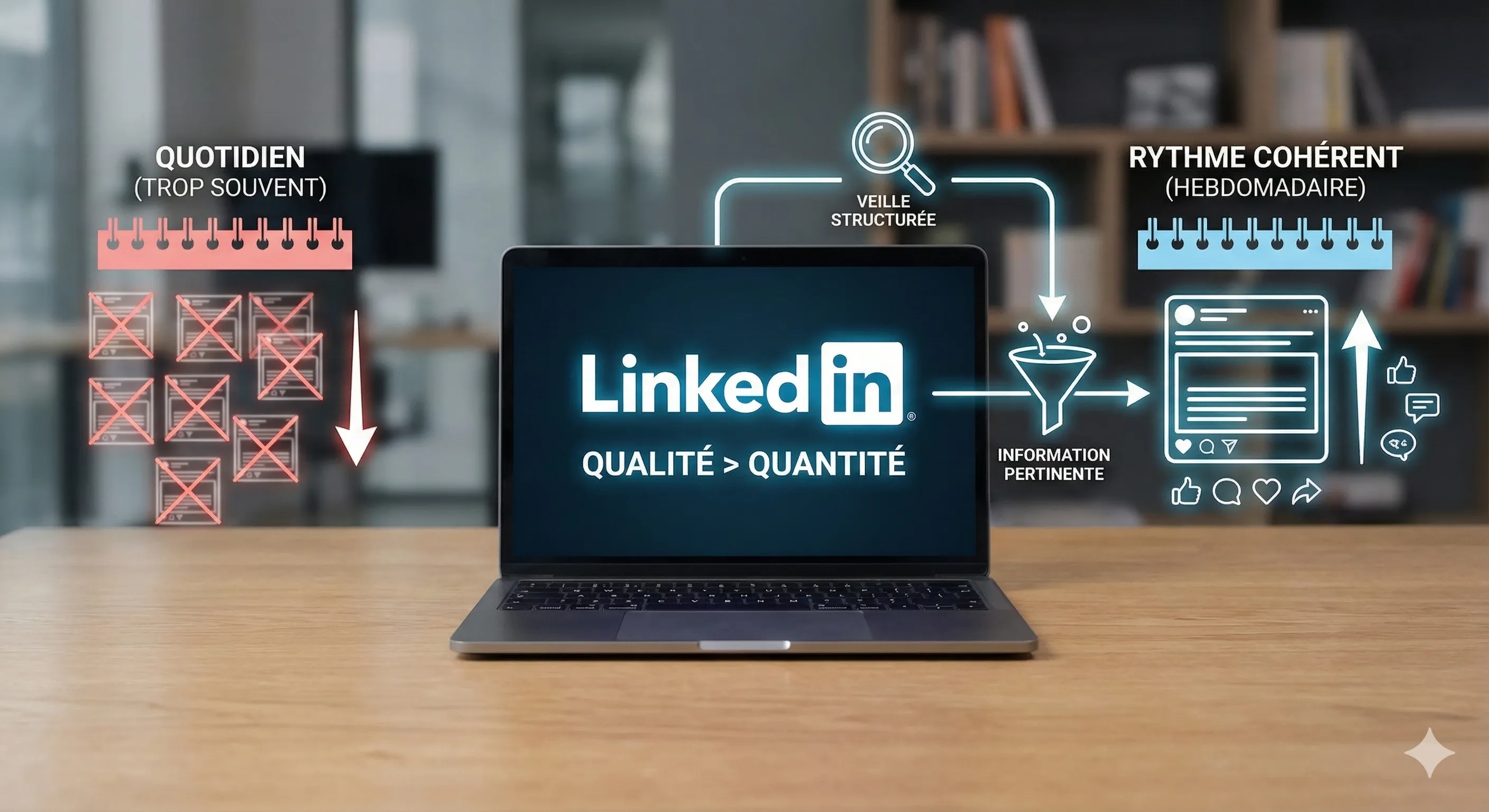
The creators growing fastest on LinkedIn are not those who post every day. They're those who publish 3 to 5 times per week with consistency over several months.
Why? Because the algorithm favors long-term regularity. A creator who has published 200 posts over 12 months benefits from a "consistency capital" that the algorithm factors into distribution.
Conversely, posting every day in "quantity mode" without varying formats or angles exhausts your audience and reduces your average engagement — which penalizes your reach.
For a deeper look at this, read Should You Still Post Every Day on LinkedIn?.
The Minimum Quality Rule
Every post you publish should pass a simple test: does this post give my audience something they don't already know, or help them see something differently?
If the answer is no, don't publish. A mediocre post doesn't just fail to deliver — it erodes the trust capital you've built with your audience.
Building a Sustainable Rhythm
The best rhythm is the one you can maintain for 12 months, not the one that gives you the best numbers for 3 weeks.
To start: 2 posts per week for 4 weeks. Then 3 posts per week for 2 months. Adjust based on your energy and results.
Finding LinkedIn Content Ideas Continuously
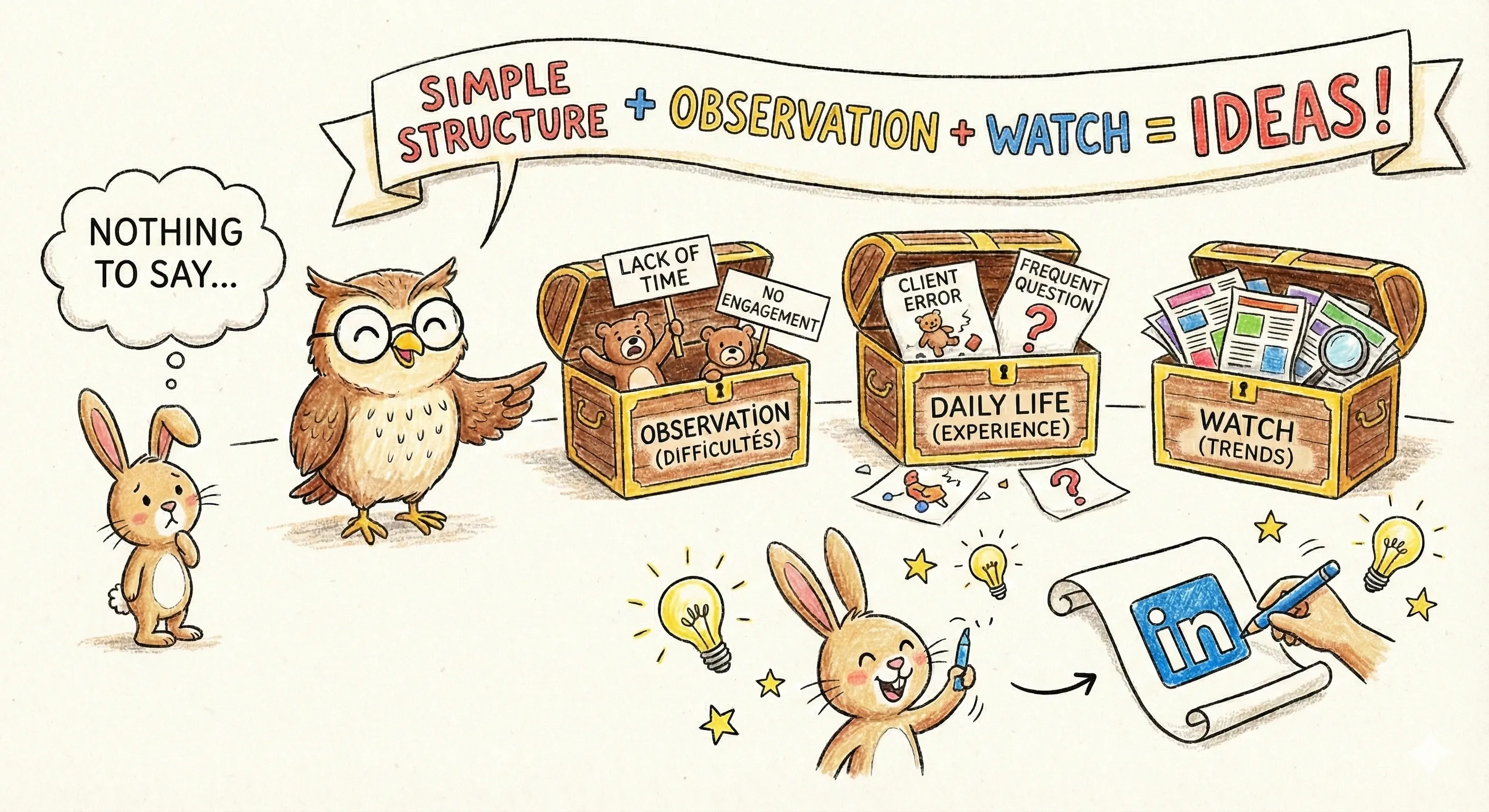
The blank page is the number one enemy of LinkedIn content creators. Yet if you work with a system, you never run out of ideas.
5 Sources of Endless Ideas
-
Your personal experiences What you live professionally is your most differentiating source of ideas. Your mistakes, successes, learnings, field observations — nobody else has exactly your perspective.
-
Questions from clients and prospects Every question a client asks you is a potential post. If someone asks "How do I know if my positioning is right?", that's a post idea.
-
Content you consume An article, a book, a podcast — not to summarize, but to react: "I read this and here's why I partially disagree." Well-argued divergence drives engagement.
-
Industry trends Not clickbait, but weak signals: a behavioral shift, an emerging trend, a tool changing practice. Be the first to cover it with a clear angle.
-
Recycling past content A post that performed well 6 months ago can be republished with a different angle. Your audience has turned over, your message has evolved — reframe it.
For a complete system of post ideas, check out How to Find a LinkedIn Post Idea.
Using AI to Generate LinkedIn Posts
In 2026, the fastest-moving content creators use AI as a production assistant — not as a replacement for their voice. AI can help you turn a rough note into a structured post, repurpose an angle into 5 different formats, or overcome blank-page syndrome.
The challenge is keeping your voice. A generic AI post is recognizable — and LinkedIn's algorithm is increasingly penalizing them. You can generate your LinkedIn posts with AI while staying authentic using Suma AI's LinkedIn post generator, which adapts to your tone and topics.
Understanding the LinkedIn Algorithm in 2026
The LinkedIn algorithm is often described as a black box. In reality, its logic is fairly well-documented if you know where to look.
The Distribution Phases of a Post
When you publish a post, LinkedIn follows a multi-step process:
- Initial distribution to a small sample of your connections (roughly 10–15%)
- Engagement measurement on that sample for 30 to 90 minutes
- If engagement is satisfactory, expanded distribution to your 2nd-degree connections
- If engagement continues, distribution into the feeds of people with no direct connection to you
The result of step 2 is decisive. That's why the first reactions (especially comments) in the hour after publication are so important.
Positive Signals the Algorithm Rewards
In decreasing order of importance:
- Comments (especially long ones and exchanges)
- Shares (direct share > share with comment)
- Saves (strong signal, often underestimated)
- Reactions ("Love" and "Insightful" are slightly favored vs. "Like")
- Reading time (LinkedIn measures whether people read to the end)
Negative Signals to Avoid
- "Hide this post": the worst possible signal
- Very little engagement in the first 30 minutes
- External links in the post body (LinkedIn penalizes posts that drive people off the platform — put links in the comments)
- Artificial engagement pods (LinkedIn detects them increasingly well)
What the Algorithm Doesn't Say
The algorithm rewards thematic relevance. If you consistently post about B2B marketing, LinkedIn eventually associates your profile with that topic and prioritizes distributing your posts to people interested in that theme. This is "topical authority" applied to LinkedIn.
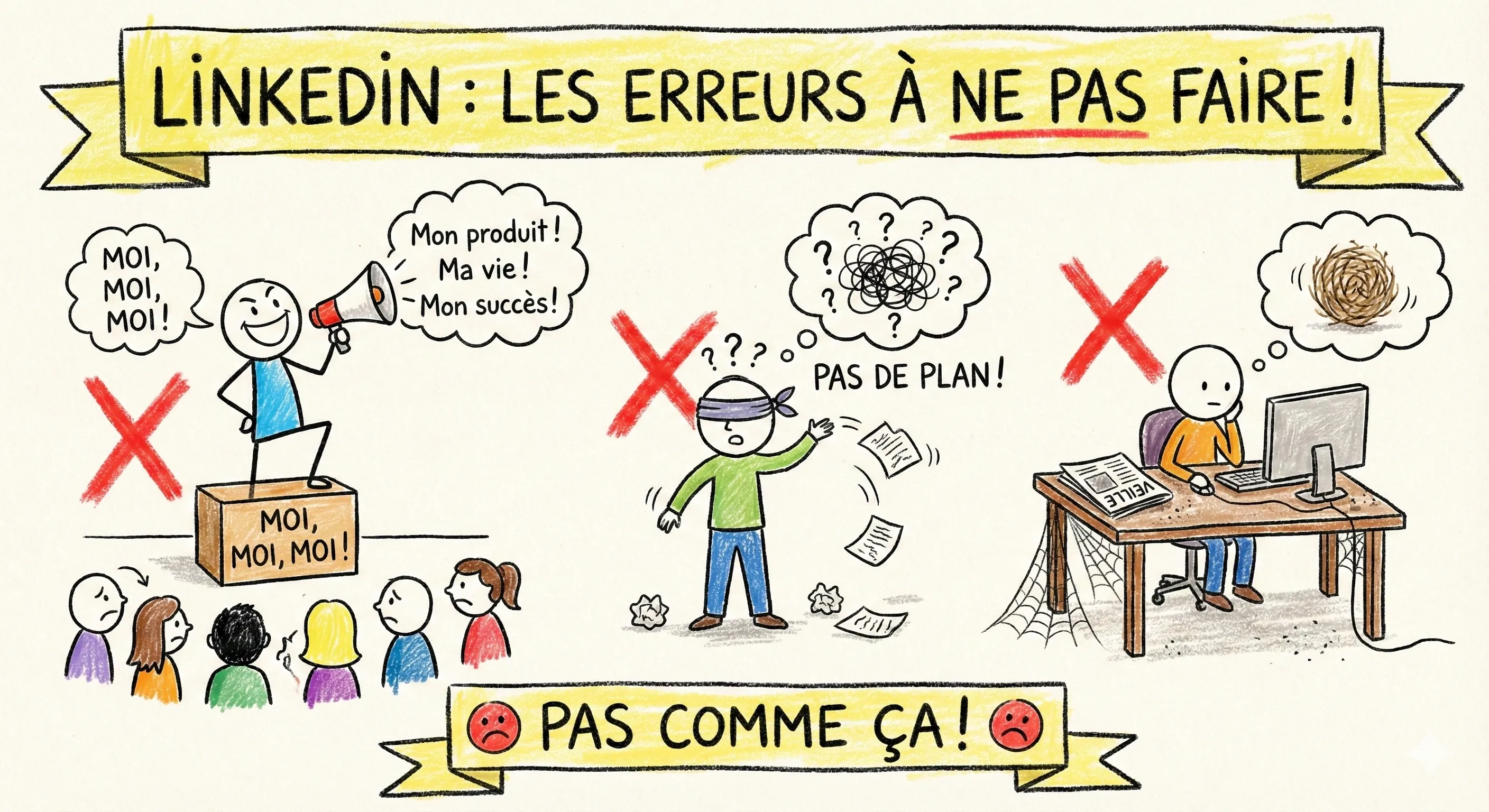
Mistakes That Tank Your LinkedIn Content
Even with the right formats and frequency, certain systematic mistakes sabotage results. Here are the main ones.
Writing for Yourself, Not Your Reader
The most common mistake. Your post must answer your reader's implicit question: "Why does this matter to me?" If you talk about yourself without creating a bridge to the reader's experience, you lose their attention.
Neglecting the Hook
70% of people never click "see more." If your first two lines don't hook them, the rest of the post doesn't exist for them.
Publishing Without Engaging
Post and disappear is a losing strategy. The 30 to 60 minutes after publication are critical: reply to comments, engage with your network's posts, be present. LinkedIn rewards profiles that are active on the platform — not just those who publish.
Lacking Thematic Consistency
Posting on 7 different topics in one week dilutes your positioning. Your audience and the algorithm need to know what you stand for. Choose 1 to 3 main themes and stick with them.
Copying Formats Without Adapting to Your Voice
LinkedIn post templates circulate everywhere. They can be useful as a starting point — not as copy-paste. If all your posts sound like someone else's posts, you're not building an audience, you're borrowing someone else's.
For a full diagnosis of what's holding your results back, read Why Your LinkedIn Posts Don't Work (and How to Fix Them).
Building a Long-Term LinkedIn Content Strategy
A good post is great. A 12-month strategy is better. Here's how to think about your LinkedIn presence over time.
Defining Your Editorial Territory
An editorial territory is the intersection of what you know how to do (expertise), what you want to share (passion or conviction), and what your audience wants to read (demand).
To find yours, answer these three questions:
- What topics could you write 100 different posts about without running out of ideas?
- What transformation do you want to help your audience achieve?
- What 3 types of people do you want to attract to your profile?
The 3 Types of Content to Alternate
To maintain engagement while building authority, alternate between three types of posts:
- Expertise posts (educational, tools, frameworks) — build your authority
- Perspective posts (opinions, positions) — build your personality
- Connection posts (personal experiences, storytelling) — build trust
A balanced ratio: 40% expertise / 30% perspective / 30% connection.
Measuring What Actually Matters
Metrics to prioritize:
- Engagement rate (reactions + comments / impressions)
- New followers per week
- Inbound connection requests tied to your posts
- Private messages that reference a specific post
What you can ignore: raw view count (vanity metric without context), likes alone.
The Role of Tools in Your Strategy
In 2026, creating LinkedIn content without support tools is like writing by hand when everyone else uses a word processor. Tools let you plan, generate variants, analyze performance, and automate repetitive tasks.
For post creation, Suma AI's LinkedIn post generator adapts to your voice, themes, and style — so you can produce authentic content faster, without sacrificing quality.
Checklist: Is Your LinkedIn Post Ready?
Before publishing, check these 10 points:
- My hook fits in 2 lines and creates curiosity or tension
- Each paragraph is 1 to 3 lines (readable on mobile)
- My post has one clear central idea (not 3 mixed together)
- I've removed all unnecessary words (adverbs, hollow phrases)
- My closing invites a specific reaction
- I haven't put an external link in the post body
- My post is consistent with my editorial territory
- I've read it aloud (if it sounds wrong spoken, it'll sound wrong written)
- I'm available for the 30 minutes after publishing to reply to comments
- This post offers something my readers won't find elsewhere
What to Take Away
LinkedIn content in 2026 is a long-term game. The creators who win aren't necessarily the most brilliant or the most visible — they're the ones who understand the rules, who publish consistently with a coherent voice, and who improve post by post.
This guide gives you the foundation. But real progress comes from practice: publish, analyze, adjust. Every week.
If you want to accelerate that process without spending hours on it, Suma AI's LinkedIn post generator is built for exactly that: give it your raw idea, it structures a post that sounds like you, in your tone, on your topics.
Start now. Your next post is already inside you.