How to Generate Leads on LinkedIn: A Practical Guide for 2026
How to Generate Leads on LinkedIn: A Practical Guide for 2026
You set up Sales Navigator, sent dozens of personalized invitations, tested three automation tools. The result: a few meetings, a lot of silence, and a LinkedIn account that is starting to get warnings. Generating leads on LinkedIn is not about prospecting faster. It is about building a system where content and prospecting reinforce each other instead of wearing each other out.
In this guide: why LinkedIn remains the most profitable B2B channel, the difference between organic content and automated prospecting, a concrete method to turn your profile and posts into a lead engine, and the rules to follow if you prospect directly.
Why LinkedIn remains the most profitable B2B channel
LinkedIn claims the majority of B2B leads generated from social media, far ahead of other platforms, according to the figures the platform shares with advertisers. The reason is simple: it is the only network where professional intent is declared by default. A job title, a company, an industry: the data is already there, you do not have to guess it.
This has a downside. Because the channel works, everyone crowds into it with the same copy-pasted prospecting messages. A decision maker now receives several requests a week, often identical. The channel is still profitable, but it rewards volume less and less, and relevance more and more.
Organic content or automated prospecting: two approaches, one choice
Before choosing a tactic, choose an approach. Both work, but they do not behave the same way over time.
| Criterion | Organic content | Automated prospecting |
|---|---|---|
| Ramp-up | Slow, first leads arrive within weeks | Fast, first contacts within days |
| Risk of account restriction | Low | Real if quotas or a human pace are not respected |
| Effect over time | Cumulative, every post stays findable and keeps working | Linear, stops as soon as the campaign stops |
| Quality of inbound leads | The prospect arrives already convinced by your point of view | The prospect discovers your offer when the message lands |
Neither column is the wrong answer. The problem starts when a company only does the second one: it prospects cold without ever building visibility, and every campaign starts from zero. The most durable method combines both, with content as the main engine and targeted prospecting as an occasional accelerator.
Optimize your profile so it converts
A complete profile is not a profile that converts. The difference comes down to one question: what does a visitor understand when they land on your profile after reading one of your comments or posts?
- Your headline describes a benefit, not a job title. "CEO at Acme" tells no one anything. "I help CFOs at mid-sized companies shorten their month-end close" gives a reason to click "View profile".
- Your banner carries a message, not a decorative logo. It is the largest and least used space on the profile.
- Your About section speaks to the visitor, not about you. Replace the résumé with what you solve, for whom, and how to reach you.
- Social proof is visible without clicking. A recent recommendation, a quantified client result, a press mention.
- Your latest visible post is less than two weeks old. An optimized profile that has been silent for three months signals that it has been abandoned.
This work is done once, then updated over the months. It conditions everything that follows: a lead who clicks on your profile after a good post and finds nothing convincing does not come back.
Generate leads with content: the 4-step method
This is the slowest part to get going and the most profitable over time. It rests on a simple principle: a lead who discovers you through a post they found useful arrives already half convinced, without a single message being sent.
Pick a narrow editorial territory
Three to four topics at most, the ones where your expertise is hardest to copy. An account that talks about everything becomes a reference on nothing, and the leads who arrive do not know exactly what you sell.
Post with a point of view, not a summary
A post that relays information without taking a position has no author: anyone could have written it. A clear point of view, backed by an example from your own work, is what gives a prospect a reason to remember your name.
Fuel that consistency with structured monitoring
The real obstacle is not writing, it is finding something to say every week without giving up your evenings. Automated monitoring of the sources in your industry, blogs, YouTube channels, competitor LinkedIn accounts, replaces the daily search with a few minutes of selection.
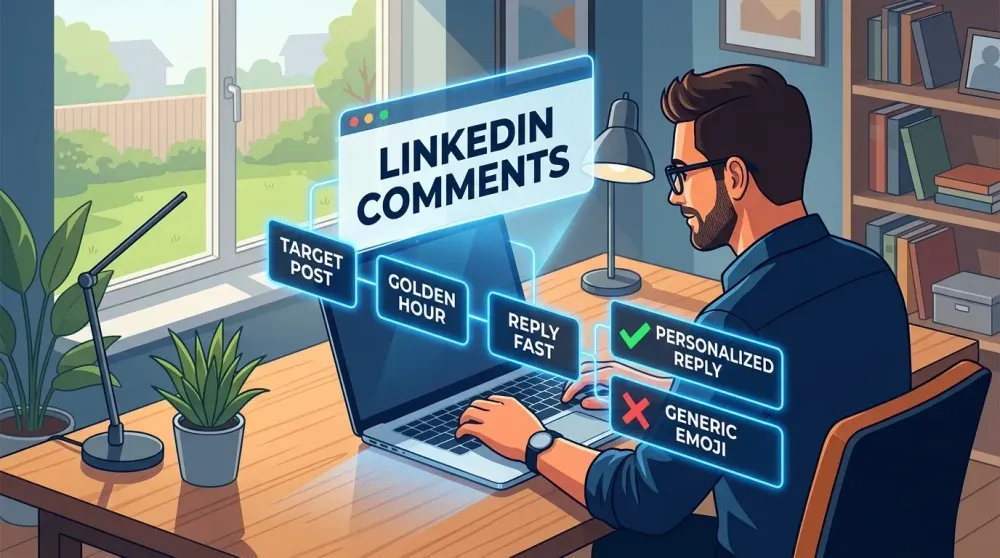
Reply to every comment within an hour of posting
This is the most neglected step, and the most profitable one. A comment left unanswered is a sales conversation that never starts.

The real brake on this method is not strategy, it is the time each step takes, week after week. That is what Suma AI automates: monitoring detects relevant topics, the tool drafts a structured post in your style in about thirty seconds, and scheduling publishes automatically at the times your audience is active.
Turn comments and DMs into qualified conversations
A like never converts. A comment does, as long as you treat it as the start of a conversation rather than a number to push up.
Three habits separate a decorative comment from one that opens a door, covered in our guide to LinkedIn comment strategy: add information the post did not have rather than generic approval; comment on your prospects' posts before writing to them, so you do not arrive as a stranger; and move to a private message only when the exchange justifies it, never as an immediate pitch.
The message that follows a good comment is written differently from a cold message. It refers to the exchange that just happened, asks an open question about the topic, and offers nothing until it understands the prospect's context. A lead who has already interacted two or three times with your content replies to this kind of message far more often than a stranger does.
If you prospect directly: the rules to avoid getting restricted
Direct prospecting is still useful to speed things up on a list of accounts you have already identified. It does, however, require more restraint than most automation tools encourage.
The limits that protect your account
Stay under 100 to 150 invitations a week and avoid any fully automated, unsupervised sending: LinkedIn detects robotic behavior and restricts the accounts involved, sometimes for a long time. A lower but personalized volume produces a better response rate than a high, generic one.
Three simple rules remove most of the risk and improve results at the same time:
- Reference something specific from the prospect's profile or activity in your first message, never a one-size-fits-all line.
- Do not propose a meeting in the first message: open with an observation or a question, the request comes later.
- Space follow-ups at least three to four days apart, and stop after two unanswered follow-ups.
Measure what works
The Social Selling Index (SSI), available for free in LinkedIn's tools, gives a useful snapshot across four areas: the strength of your professional brand, the relevance of your network, your level of engagement with targeted content, and the strength of the relationships you build. A rising score is an encouraging sign, but it is not what fills your pipeline.
The indicators that really matter are simpler to track: the number of qualified comments per post (from your target audience, not your close network), the response rate to messages that follow a previous interaction, and the number of conversations that turn into a call or a demo each month. Track these three numbers for eight to ten weeks before judging a method: content takes time to produce its first effects, but those effects then add up.
Frequently asked questions
Allow six to eight weeks of consistent posting before you see your first quality inbound leads. Direct prospecting can produce meetings faster, but the two rhythms are not comparable: one stops with the campaign, the other keeps producing results months after you post.
Key takeaways
Generating leads on LinkedIn is not about a single tool, it is a system: a profile that converts, content that builds a reputation over time, comments and DMs treated as real conversations, and direct prospecting used with restraint rather than in volume.
Content is the slowest part to set up and the hardest to keep up week after week. It is also the part that keeps producing leads long after you post, without exposing your account to restrictions.