How to Keep Up With Industry Trends (and Post About Them)
How to Keep Up With Industry Trends (and Post About Them)
You know you should be posting on LinkedIn, yet every Monday the same question comes back: what should I talk about this week? The problem is rarely a lack of talent. It is the lack of a system to keep up with industry trends: thirty open tabs, unread newsletters, and ideas that vanish before you ever use them.
In this guide: a clear definition of industry monitoring, a one-hour setup, a 30-minute weekly routine to keep it running, and how to turn what you spot into LinkedIn posts that carry your point of view instead of a bare link share.
What is industry monitoring?
Industry monitoring is the organized tracking of your sector: market shifts, innovations, regulatory changes, research, and what the people who matter are saying. The goal is not to hoard information. It is to spot early what will change the way your customers work, decide or buy.
It is often confused with competitive intelligence. The two overlap, but they answer different questions.
| Industry monitoring | Competitive intelligence | |
|---|---|---|
| Core question | What is changing in my market? | What are my competitors doing? |
| Scope | The whole ecosystem: customers, experts, regulators, media | A handful of named companies |
| Typical sources | Research, trade media, experts, podcasts | Competitor websites, offers, hiring, announcements |
| Use on LinkedIn | Fuels analysis and opinion posts | Sharpens your positioning, rarely a post topic in itself |
For a founder, consultant or marketing lead who wants to stand out on LinkedIn, industry monitoring pays off the most: it supplies the raw material for everything you say.
Why keeping up with industry trends fuels your LinkedIn content
Posting consistently means consistently having something to say. Personal stories and lessons learned run dry fast when you post two or three times a week. Your market, on the other hand, never stops producing news: a study, a launch, a rule change, a debate between experts.
B2B decision makers are looking for exactly this kind of content. The 2025 Edelman and LinkedIn B2B Thought Leadership Impact Report, based on nearly 2,000 professionals, shows how much they value analysis that moves them forward.
91%
of buyers want content that reveals a challenge or opportunity they had not seen
86%
prefer content that challenges their assumptions
65%
prefer a human, informal tone over an academic one
In other words, your audience does not want a news recap. They can get that anywhere. They want your take on the news. Without monitoring, you have nothing to take a view on. Without a view, your monitoring only benefits you.
How to set up industry monitoring in one hour
Effective monitoring does not require expensive software or a dedicated team. It requires a clear scope and well-chosen sources. Here is the setup: do it once, then revisit it every quarter.
Write down the three questions your monitoring must answer
Start from your audience, not your curiosity. An HR consultant working with HR directors at small companies might pick: what is changing in employment law, how candidate expectations are evolving, and which tools are reshaping hiring. Anything that answers none of these questions is out of scope.
Pick 15 to 25 sources
Mix the formats: two or three trade publications, a few expert blogs, two or three YouTube channels or podcasts, and around ten LinkedIn accounts that publish analysis rather than self-promotion. Above 25 sources, you will stop reading. Below 10, you will go in circles.
Put everything in one place
Monitoring scattered across your inbox, your bookmarks and your LinkedIn feed will not survive two weeks. Group your sources in an RSS reader, a monitoring tool or a single workspace. The goal: one window to see it all.
Create a place to store ideas
A note, a spreadsheet or a board, it does not matter. What matters is that every item you keep lands there with one line on what you think about it. An idea saved without your opinion is an idea lost.
Which sources should you follow?
Each type of source brings something different. Good monitoring combines them.
| Source type | What it gives you | How it becomes a post |
|---|---|---|
| Research and reports | Fresh, quotable numbers | Comment on a figure that contradicts a common belief |
| Trade media | Announcements and industry changes | Explain what an announcement changes for your clients |
| Expert blogs | In-depth analysis | Argue for or against a thesis |
| YouTube and podcasts | Long conversations full of quotes | Pull out one strong idea and test it against your experience |
| LinkedIn accounts | The debates your audience is having | Join a discussion with a fresh angle |
The weekly routine: 30 minutes to triage, not to read
The most common mistake is confusing monitoring with reading. You do not need to read everything. You need to triage fast and keep only what can become something you say publicly.
Block a fixed slot, say Friday from 9:00 to 9:30, and sort each item into one of three piles:
- Post: the news directly affects your audience and you have an opinion on it. It becomes a post next week.
- Comment: the topic is interesting but does not deserve a full post. A thoughtful comment under someone else's post will do.
- Archive: useful background, nothing more. You will probably never reread it, and that is fine.
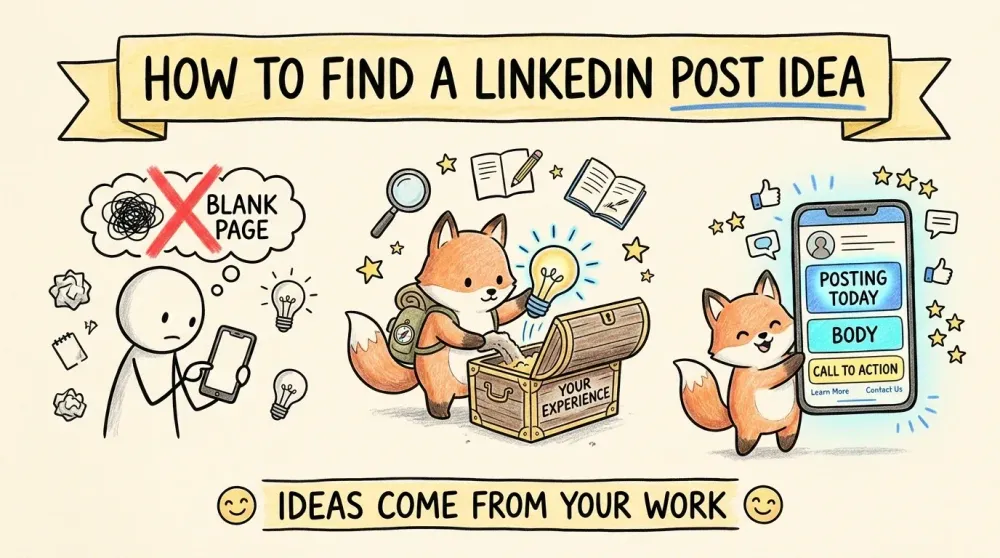
A normal week produces two or three items in the first pile. That is exactly what you need to post consistently without ever starting from a blank page. If you want more ways to find topics beyond monitoring, read how to find LinkedIn post ideas.
From industry news to LinkedIn post: find your angle
Sharing a link with "Interesting read, thoughts?" builds nothing. What gives a monitoring-based post its value is the angle. Three angles work reliably:
The "what this means for you" angle
You translate general news into the language and stakes of your audience. A new EU regulation becomes "what this actually changes for a 30-person company hiring full-time staff".
The "I disagree" angle
You push back on a popular idea, with arguments. It is the most engaging angle, and the one B2B buyers say they prefer, as long as it is backed by your experience rather than a wish to provoke.
The "what I see in the field" angle
You test a study or trend against what you observe with your own clients. A national statistic becomes credible, or questionable, once you compare it to real cases.
Here is an example. A SaaS marketing director spots a study in her feed saying B2B buyers talk to sales reps less and less. Instead of sharing it, she writes about what that changed in her own campaigns: the three pieces of content that replaced her first sales calls, and the one that went nowhere. Same source as hundreds of other people, but a post nobody else could have written.
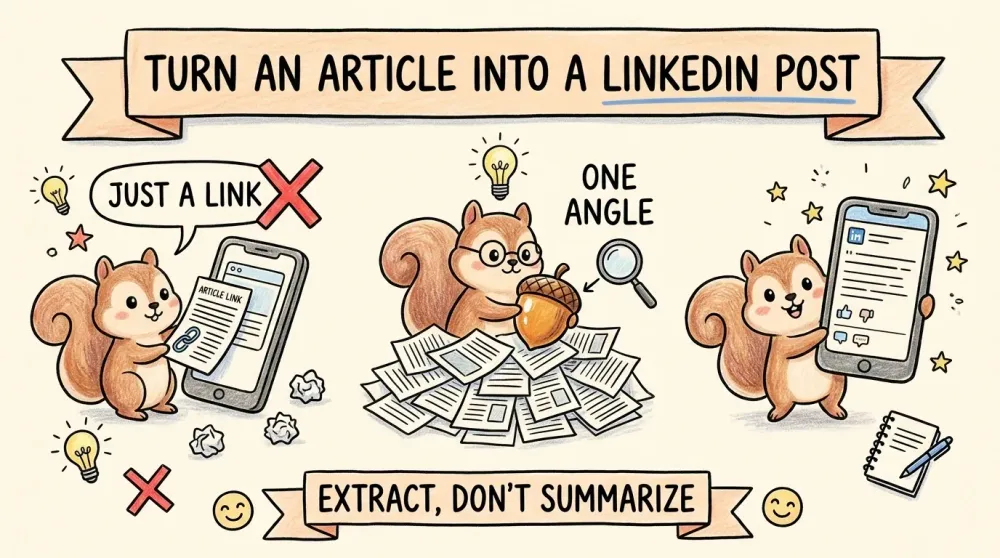
For the step-by-step method to turn a source into a structured post, see our guide on turning an article into a LinkedIn post.
Industry monitoring tools: which one should you pick?
The best tool is the one you will actually open every week. Here are the most common options, depending on what you need.
| Need | Google Alerts | RSS reader (Feedly, Inoreader) | LinkedIn notifications | Suma AI |
|---|---|---|---|---|
| Track keywords across the web | Yes | Partly | No | No |
| Centralize blogs and media | No | Yes | No | Yes |
| Follow YouTube channels | No | Yes, via RSS | No | Yes |
| Follow LinkedIn accounts | No | No | Yes, one by one | Yes |
| Turn a source into a post | No | No | No | Yes |
Google Alerts is still handy for tracking a brand name or an exact phrase. An RSS reader works well if you read a lot and post little. If your goal is to post consistently on LinkedIn, a tool that connects source monitoring to LinkedIn post generation saves you the most expensive step: going from "that's interesting" to a first draft.
Mistakes that turn monitoring into wasted time
- Following too many sources. After three weeks, you read nothing and feel guilty. Fifteen sources you read beat eighty you ignore.
- Following only the media. You will see the same news as everyone else, at the same time. Niche experts and LinkedIn accounts give you the weak signals.
- Reading without writing anything down. A piece of news you have not commented on in writing within 24 hours will never become a post.
- Posting the news without an opinion. A post that summarizes an announcement without taking a position does not set you apart. Your audience has already read the announcement.
- Never reviewing your sources. A source that produced nothing useful in a quarter should come off the list.
For the bigger picture of the content strategy your monitoring feeds into, read our complete guide to LinkedIn content.
Frequently asked questions
Start by writing down three questions your monitoring must answer, based on what your audience cares about. Then pick 15 to 25 varied sources (trade media, experts, YouTube, LinkedIn accounts), gather them in a single tool, and block 30 minutes a week to decide what deserves a post, a comment, or simply the archive.
Key takeaways
Industry monitoring is not a research-department chore reserved for large companies. It is the system that keeps you away from the blank page, because it hands you fresh material to take a position on every week. Three questions, about twenty sources, one place to read them and 30 minutes of triage a week are enough to keep it running.
Want to post consistently without giving up your evenings? Start for free, no credit card required.