LinkedIn Company Page vs Personal Profile: The 2026 Guide
Not sure whether to post from your company's LinkedIn page or from your personal profile? The question comes up every time a content strategy is launched, and the answer is almost never the one people expect: it is not about picking a side, but about understanding what each one is for, then making them work together.
Company page or personal profile: a false dilemma
On LinkedIn, the company page and the personal profile do not play the same role, which is exactly why the question "which one should I choose" often leads nowhere. A company page is an institutional showcase: it reassures, it recruits, it serves as an anchor for your teams and future clients. A personal profile carries a voice: that of a founder, a salesperson or an expert, and that voice is what captures attention in a feed saturated with corporate content. Before deciding, it is worth looking at what recent figures show, then deciding who in your company should post where.
What the 2026 data says: who wins on engagement
A 2026 Metricool study of more than 673,000 LinkedIn posts comes down clearly in favor of the personal profile for engagement, and in favor of the company page on one specific metric: shares (Metricool LinkedIn Study 2026).
+63%
more engagement on a personal profile vs a company page
+238%
more comments on personal profiles
15x
more shares on average for company pages
Another finding from the study: past 100,000 followers, a personal profile's impressions and comments are multiplied by 6. The algorithm does not penalize new accounts either: a profile that is just starting out has the same chances of engagement as an established one, as long as the content is relevant.
| Criterion | Personal profile | Company page |
|---|---|---|
| Engagement and comments | Much higher | Lower |
| Shares | Lower | 15x higher |
| Organic reach without budget | Strong, especially past 100,000 followers | Limited |
| Institutional credibility | Weak on its own | Strong |
| Hiring and job posts | Not available | Yes |
| Advertising (LinkedIn Ads) | Not available | Yes |
The personal profile: the engine of attention
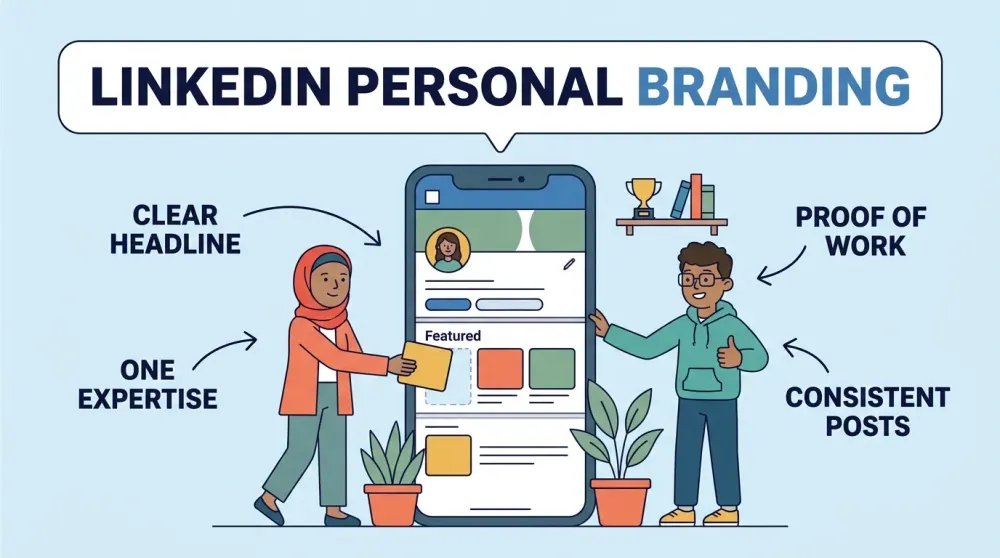
People respond to people, not to logos. A post published by a founder or a salesperson, with a clear point of view and a recognizable tone, naturally triggers more comments than an institutional announcement, because it invites conversation rather than passive reading. That is the whole point of personal branding: building, post after post, an identifiable voice that your prospects trust before they even look at your company name. To go further, our guide to LinkedIn personal branding explains how to lay the foundations of a consistent personal editorial line.
The challenge for a founder or a salesperson is keeping that consistency without giving up their evenings. That is where tone personalization helps: by learning your style from a few existing posts, a tool like Suma AI can generate drafts that already sound like you, rather than generic text you have to rewrite from scratch.
The company page: what it is really for
The company page is not built to win the engagement battle; it serves other, equally real goals. It is what shows up when a prospect types your company name into LinkedIn search, and its seriousness (logo, description, regular posts) is what reassures them when they check that you really exist. It also carries your job posts, your LinkedIn Ads campaigns, and detailed statistics on your performance by audience.
Running a company page requires a different discipline from a personal profile: less spontaneity, more structure (case studies, product announcements, team news). Our article on how to grow a LinkedIn company page details the concrete levers to break through the ceiling of a few dozen followers where many pages get stuck.
How to combine the two without spreading yourself thin
Rather than choosing, most companies that get results on LinkedIn split the roles. This synergy between page and profile is what several practitioners recommend for 2026, and Refine Labs' data on employee profiles versus brand pages points the same way. Here is the order that works best in practice.
Have leaders and salespeople post on their profiles
That is where most of the engagement and first contacts happen. A CMO who posts three times a week from their profile usually generates more conversations than a company page that posts every day.
Build a complete, up-to-date company page
Logo, banner, clear description, link to the website, a few recent posts: the goal is credibility at first glance, not volume.
Have the page amplify personal posts, not the other way around
The company page can repost or comment on leaders' best posts, giving them a second life without duplicating the writing work.
Keep the company page for the formats it serves best
Job posts, product announcements, case studies, ad campaigns: these are its strengths, where a personal profile would feel off-topic.
Special cases: freelancer, SMB, scale-up, large company
The right split also depends on the size and model of your business.
Freelancer or consultant: your personal profile is almost always enough. A company page adds a layer of management with no real benefit as long as you are the only one posting.
Growing SMB or startup: the founder's profile should carry most of the content, while the company page is built in parallel so it is ready the day you hire or launch paid campaigns.
Scale-up or established company: several profiles (leaders, salespeople, product experts) post in parallel, and the company page becomes the point of convergence that validates and amplifies their best content.
Large company or well-known brand: the company page can legitimately take the lead, because the brand carries more weight than any individual, especially on institutional topics or high-volume hiring.
Mistakes that sink a LinkedIn company page
The most common pitfalls
- Posting only institutional announcements, without ever reposting or commenting on what your teams say.
- Leaving the page silent for weeks: the algorithm rewards consistency, not isolated spikes.
- Putting external links in personal profile posts: they reduce organic reach, unlike on a company page where they are fairly well tolerated.
- Confusing the company page with a news feed: the page should remain a place of proof, not a generic stream of industry news.
Frequently asked questions
Not necessarily. If you are the only one posting, your personal profile already captures most of the engagement and credibility. A company page becomes useful once you hire, run LinkedIn Ads campaigns, or your business grows beyond you alone.
Key takeaways
Company page or personal profile is not a question to settle once and for all, it is a split to organize: the personal profiles of leaders and teams carry engagement and conversation, the company page carries credibility, hiring and advertising. The two channels reinforce each other when treated as complementary rather than competing, with a consistent flow of content between them.
Want to post regularly on your profile and your company page without giving up your evenings?