How to Find Freelance Clients on LinkedIn: The Method
How to Find Freelance Clients on LinkedIn: The Method
You optimized your profile, published a few posts, and still no messages from prospects. LinkedIn has a reputation as the must-have network for freelancers, but many discover that a passive presence never brings in a single project.
In this guide: the foundations to lay before prospecting, the method to turn an audience into sales conversations, a prospecting message framework that gets replies, and how to respond to project calls without sounding like every other applicant.
Why LinkedIn is not bringing you clients (yet)
If LinkedIn has brought you nothing so far, the cause is almost always the same: a profile that talks about you rather than the client's problem, and activity too irregular to build a relationship with anyone.
A post along the lines of "I'm available, here's my résumé" solves no problem for the person reading it, so they do not react. A profile without clear positioning does not tell a busy visitor why they should contact you rather than another freelancer. And a post every two months never gives an audience time to build up.
None of this is fixed with a single post, however polished. It is fixed with a method that rests on four pillars: positioning, profile, regular presence and active prospecting.
Lay the foundations before prospecting
Choose sharp positioning
A freelancer who introduces themselves as a "web developer" speaks to everyone, so to no one in particular. A freelancer who introduces themselves as a "Shopify developer for brands that want to boost their conversion rate" speaks directly to the person with that exact problem, and sticks in their mind.
Positioning comes from combining three elements: the skill you master best, the type of client you work best with, and the concrete problem you solve. All three should appear, one way or another, in your LinkedIn headline.
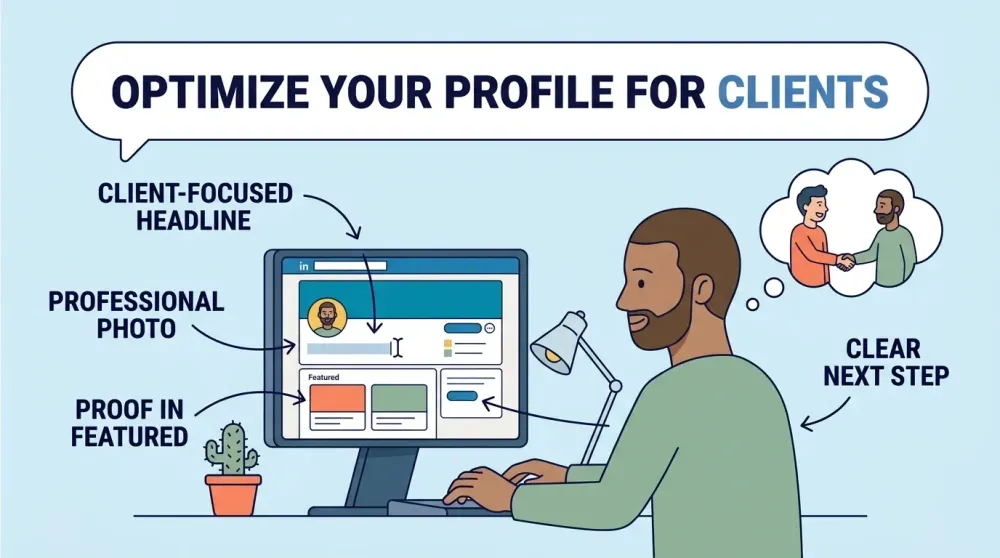
Focus your profile on the client, not your résumé
A freelancer's LinkedIn profile often reads like a résumé: job titles, dates, lists of skills. That is useful for a recruiter, much less for a prospect who wants to know in ten seconds whether you can solve their problem.
Your banner, headline and About section should answer one question: what do I gain by contacting you? Past experience is better rephrased as results delivered for a client than as a list of tasks. How to optimize your LinkedIn profile to attract clients explains, section by section, what turns a profile that informs into one that converts.
Show visible social proof
A client recommendation, a quantified case study or a post detailing a real project carries more weight than a list of self-declared skills. Asking for a recommendation at the end of every successful project, then displaying it prominently on your profile, takes five minutes and reassures any prospect who is still hesitating.
Build a presence that attracts clients without giving up your evenings
A well-built profile is not enough if it stays static: LinkedIn rewards consistency, and a prospect needs several touchpoints before trusting you.
The rule that comes up most often among freelancers who make a living from LinkedIn is an 80/20 split: about 80% useful content (a lesson learned, practical advice, an analysis of a problem your ideal client faces) and only 20% content that talks directly about your offer, as laid out in LiGo's guide to LinkedIn for freelancers.
This is also where the LinkedIn personal branding method helps you go the distance: a clear editorial line saves you from wondering every week what to post, and gives your audience a reason to come back.
Use social selling to turn engagement into clients
Posting regularly builds an audience, but an audience does not turn into clients on its own. Social selling means spotting signals of interest (repeated likes, comments on several posts, a profile visit) and turning that signal into a private conversation at the right moment.
Reaching out to someone who has never interacted with you is classic cold prospecting, with the same disappointing response rate. Reaching out to someone who has already shown a signal of interest changes everything: you are not starting a conversation with a stranger, you are responding to interest that has already been expressed.
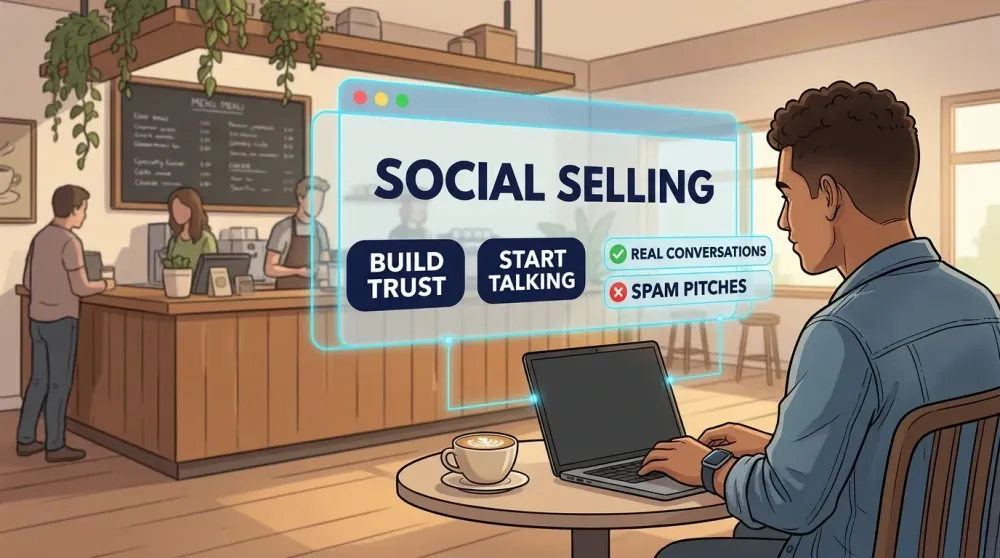
In practice, that means tracking who interacts with your posts each week, and starting a private conversation as soon as the same person comes back three or four times, rather than waiting for them to make the first move.
Prospect directly: the message that gets a reply
Social selling does not cover everything: some prospects will never see your posts, and direct prospecting is still needed to round out your flow of projects. The difference between an ignored message and one that gets a reply almost always comes down to personalization.
Say why this company
One sentence that shows you have really looked at the company (a recent launch, an open role, content they published), not a copy-pasted message sent to fifty profiles.
Say why you
One sentence that connects your specific skill to the problem you just identified at their company, without walking through your whole career.
Say why now
A concrete reason to act at this exact moment, for example limited availability or a result you recently achieved on a similar project.
End with an open question, not an offer
"Is this on your radar right now?" gets more replies than a direct sales pitch in the very first message.
Aim for five to ten targeted messages a day rather than a mass, unpersonalized send: the quality of targeting matters more than volume, especially on a network where a generic message is spotted instantly.
Respond to project calls without sounding like everyone else
Posts announcing a search for a freelancer often get dozens of comments like "interested, I'll DM you", which add no information and get lost in the crowd.
A comment that mentions a specific point of the announced project, asks a relevant question about the need, or refers to a similar project you have already delivered immediately stands out from generic replies. The goal is not to convince in the comment, but to give the person hiring a reason to open your profile first.
Build a funnel rather than one-off prospecting pushes
One-off prospecting produces one-off results. To get a steady flow of projects, awareness content, social selling and direct prospecting need to work together rather than alternate at random depending on how busy the week is.
That is exactly what a LinkedIn sales funnel organizes: content that makes you known, interactions that build trust, then targeted prospecting reserved for people who have already shown a signal. Without this structure, each action stays isolated and chance decides whether a project comes in this month.
1.3B
LinkedIn members worldwide in 2026
80/20
useful content vs selling content, the ratio that works
LinkedIn now has more than 1.3 billion members worldwide, according to Hootsuite's LinkedIn statistics. On a network this dense, a freelancer who simply exists without a method gets lost in the flow; one who sticks to a structure, even a simple one, ends up being noticed by the right people.
Keep the pace when you are running everything alone
For a freelancer, the hard part is rarely the method itself: it is sticking to it over time without a marketing team. Monitoring (keeping track of what is happening in your industry), writing, publishing and prospecting all compete for the same time as client work, which remains the priority.
Two choices limit the damage. First, cut the number of content types rather than the quality bar: two genuinely useful posts a week beat a generic daily post. Second, automate what can be automated without losing authenticity, especially industry monitoring, which takes a disproportionate amount of time relative to its value once it is no longer manual.
Frequently asked questions
Yes, as long as you do not settle for a passive profile. Clear positioning, a client-focused profile, regular activity and targeted prospecting turn LinkedIn into a reliable acquisition channel, even if it takes more method than simply signing up.
Key takeaways
Finding freelance clients on LinkedIn does not depend on a viral post or a single trick, but on four pillars that reinforce each other: sharp positioning, a client-focused profile, a regular presence, and prospecting that targets the right signals rather than everyone at once.
Want to post regularly without giving up your evenings? Start for free, no credit card required.