LinkedIn Employee Advocacy: The Practical Guide for 2026
Your employees reach on average ten times more people than your LinkedIn company page, and most marketing teams never make use of it. That is the whole point of LinkedIn employee advocacy: turning your employees' personal networks into a distribution channel, instead of relying solely on a company page whose organic reach shrinks year after year. Here you will find a six-step method to launch a program that lasts, the metrics to track, and the structural mistake that makes most attempts fail.
What is employee advocacy on LinkedIn?
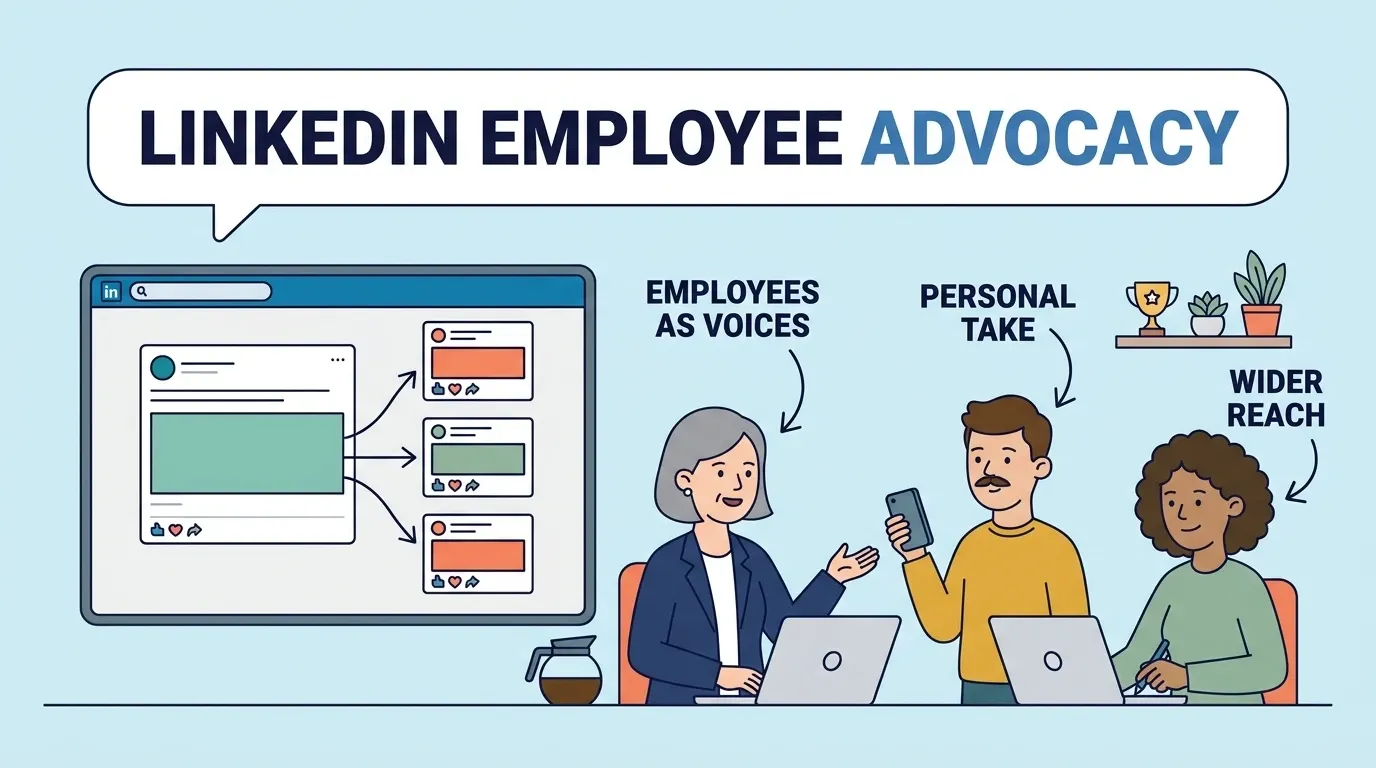
LinkedIn employee advocacy means a company's employees share, comment on or publish professional content from their own accounts, rather than leaving the company page to carry communication alone. Employees' combined networks are usually ten times larger than the company page's follower count, which explains the gap in reach between the two channels.
It is not the same as LinkedIn social selling, which targets sales prospecting directly. Advocacy is broader: it involves all employees, not just salespeople, and serves awareness, employer brand and trust first, before serving sales.
Why launch an employee advocacy program
Three arguments come up consistently in studies on the subject, and they match what you can observe on the most active B2B LinkedIn pages.
8×
more engagement for a post shared by an employee than by the company page
78%
of employees trust their employer, versus 64% for businesses in general
3%
of employees share company content on any given day
Trust explains much of the gap: a message from an employee is perceived as more credible than one from leadership or the brand, according to the Edelman Trust Barometer, compiled by Vulse. On the recruiting side, companies whose employees are active on social media attract candidates more easily, as candidates increasingly look at the profiles of their future colleagues before applying.

The concentration trap: when one person carries the whole program
This is the least discussed angle, yet the most decisive for what comes next. A LinkedIn data analysis by MagicPost shows that a single person, most often the CEO, captures between 70 and 96% of total advocacy reach in most of the companies observed (ColdIQ, Capgemini, SAP, IBM, Oracle). By contrast, organizations where reach is better distributed (HubSpot, Clay, Google) land closer to 30 to 40% for the top voice.
This concentration is a risk, not a success. The day that executive changes roles, leaves, or posts less, the whole program collapses with them: that is exactly what happened at Salesforce, where the reach share of the most-followed person jumped from 29% to 54% after another key contributor left. An employee advocacy program worthy of the name spreads the voice across several people, not just one.
How to launch a LinkedIn employee advocacy program in 6 steps
Get leadership buy-in and set goals
An advocacy program without a sponsor at leadership level stops at the first dip in activity. Set two or three measurable goals (cumulative impressions, website traffic, applications received) before recruiting the first ambassador.
Write a simple sharing policy
One page is enough: what is encouraged, what is forbidden (confidential information, non-public figures), and three or four examples of successful posts. A policy that is too long never gets read.
Recruit ambassadors on a voluntary basis
Identify 5 to 10 employees who are already comfortable on LinkedIn, across different teams (sales, product, support, HR). Forced participation produces hollow content that readers spot immediately.
Make sharing easy with ready-to-post content
This is the step that separates a program that lasts from one that fizzles out in a month. A motivated employee with no topic in mind will write nothing. Tools like automated monitoring of LinkedIn, YouTube and blog sources surface industry trends, and LinkedIn post generation from an article or video gives each ambassador a first draft in their own style in about thirty seconds, to review and personalize before publishing.
Recognize contributions without distorting the approach
An informal monthly ranking, a shout-out in a team meeting or direct feedback from marketing is enough. Avoid bonuses tied to the number of posts: they push people to post for the sake of posting, not to post well.
Measure and adjust every quarter
An advocacy program is never set in stone. Review the list of active ambassadors, the content that worked best, and the topics nobody cared about, then adjust the next quarter's brief.
Which metrics to track to measure the program
Three families of metrics cover the essentials, provided you track them over time rather than on a single post.
| Metric | What it measures | Where to find it |
|---|---|---|
| Ambassadors' cumulative impressions | The real reach generated outside the company page | LinkedIn analytics for each profile, aggregated manually or with an advocacy tool |
| Participation rate | Share of ambassadors active over a given period | Number of posts sent vs number of registered ambassadors |
| Traffic and conversions from shared links | The real business impact, beyond visibility | UTM parameters on each link, tracked in your LinkedIn analytics |
Set a baseline before launch: average impressions on future ambassadors' personal pages, current traffic coming from LinkedIn. Without that starting point, you cannot show progress three months later.
The mistakes that drain an advocacy program in a few weeks
Four mistakes come up in almost every abandoned program.
Making participation mandatory. An employee who posts under pressure produces generic text with no personal angle, which their network ignores. Voluntary participation is not a detail, it is a condition for success.
Providing content to copy and paste word for word. Ten employees posting the same sentence in the same week look like an ad campaign, not individual voices. Starter content should stay a draft to adapt, never a final text.
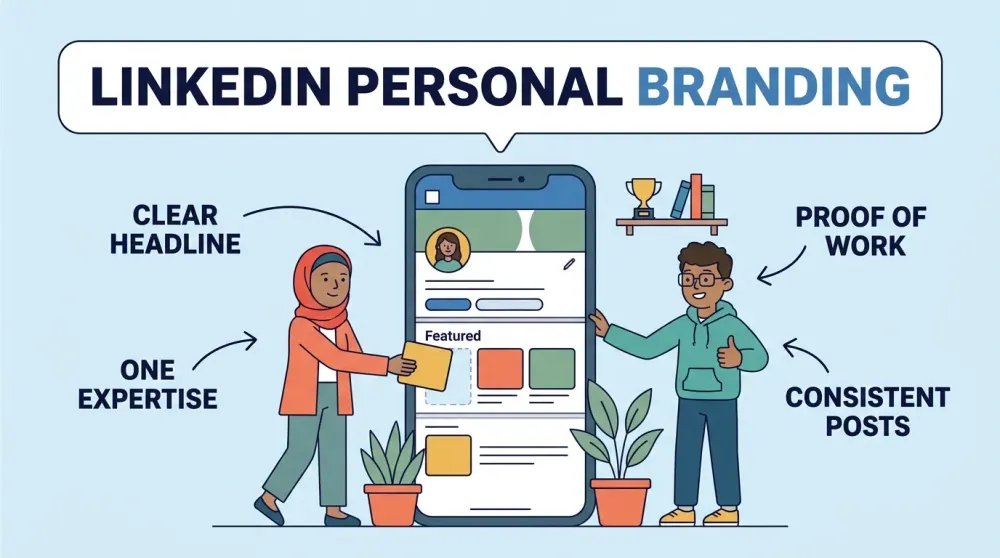
Forgetting to train ambassadors. Few employees naturally know how to structure an effective LinkedIn post. A guide to the ideal structure of a post or a 30-minute session on LinkedIn personal branding radically changes the quality of the first posts.
Never following up with ambassadors. A program launched then left without follow-up dies quietly. A five-minute monthly check-in, even informal, keeps engagement up far more effectively than a sophisticated tool.
Frequently asked questions
It is a setup that encourages a company's employees to share, comment on or create professional content from their personal LinkedIn accounts. The goal is to extend the reach of the company's communication beyond its official page, building on the trust people place in individuals rather than brands.
Key takeaways
A LinkedIn employee advocacy program is not just about asking employees to share the company page from time to time. It relies on a simple policy, volunteer ambassadors, content that is easy to personalize, and regular follow-up that keeps a single person from carrying the full weight of reach. The companies that succeed over time are the ones that treat advocacy as a program, not a one-off campaign.