LinkedIn Prospecting Message: The Practical Guide for 2026
LinkedIn Prospecting Message: The Practical Guide for 2026
You sent dozens of LinkedIn prospecting messages this week, and most of them got no reply. The problem is almost never the product or the price: it is a message that looks like all the others, written without any research on the person receiving it.
Here you will find a proven message structure, five examples ready to adapt to the context, a follow-up rhythm that does not wear out the prospect's patience, the LinkedIn technical limits to know before automating anything, and the mistakes behind most disappointing response rates.
Why most LinkedIn prospecting messages get no reply
A generic prospecting message gives itself away in one sentence: it could be sent to anyone, in any industry. The prospect immediately files it as spam and moves on, often without even opening the sender's profile.
The second cause is speed. Many messages pitch the offer, then ask for a meeting, from the very first line. Evaboot's LinkedIn prospecting guide shares a researched, personalized message template that gets a 28% reply rate, while generic outreach averages closer to 5% (5.44% in an outreach study summarized by Simular). The gap does not come from the quality of the product being sold, it comes from how the message was prepared.
How regularly you post also plays a role, upstream of the message itself. A prospect who has already seen your name in their feed is more willing to open a message from you. It is one more reason to keep an active editorial line on LinkedIn, beyond direct prospecting alone.
The structure of a LinkedIn prospecting message that gets replies
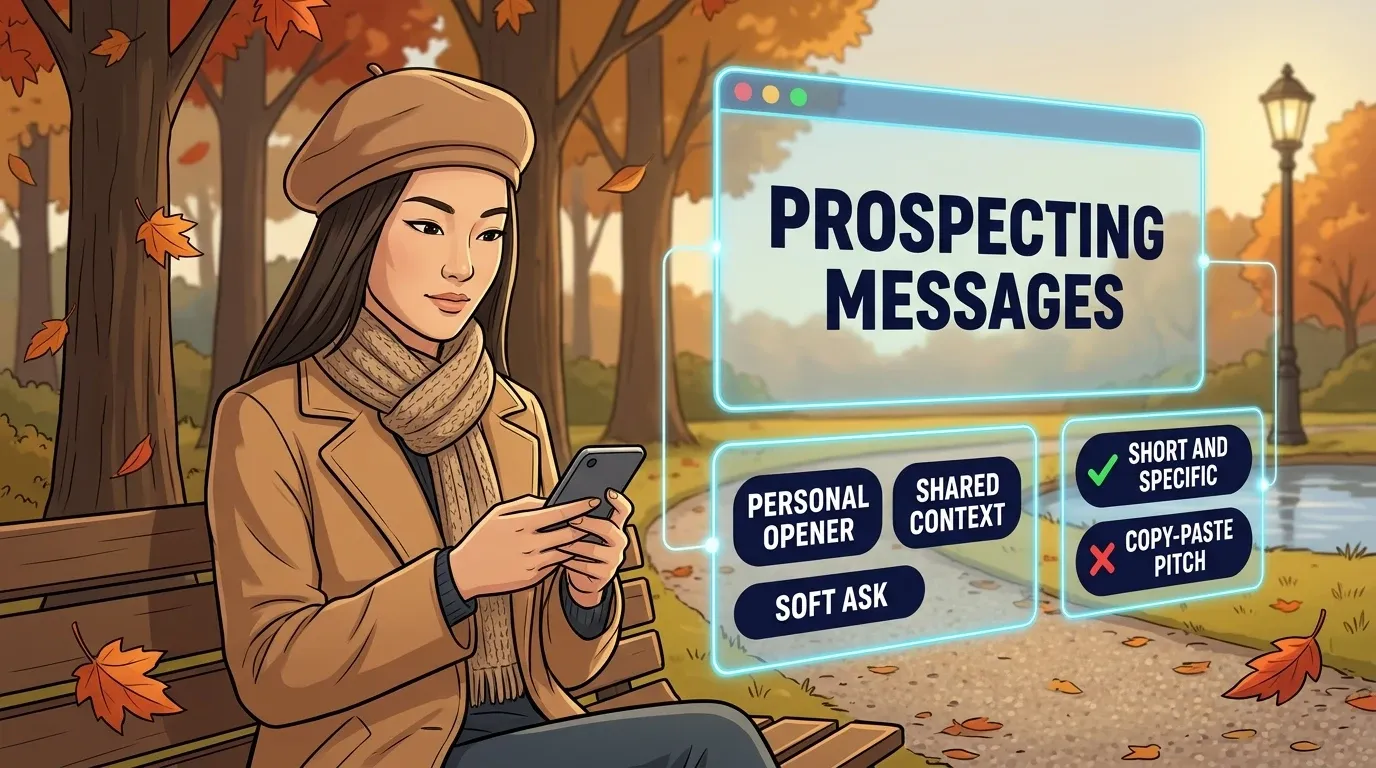
A good prospecting message runs 50 to 150 words and carries a single intention. Four elements, in this order, form a structure that holds up.
A personalized hook
Start from a real, recent fact about the prospect: a post they commented on, a new role, news from their company. One sentence is enough, as long as it proves you looked at their profile before writing.
Perceived value, not an offer
Explain in one sentence what you bring to someone in their situation, without describing your product in detail. The prospect needs to understand why you are writing to them, and not to the person in the next role over.
Subtle social proof
A number, the name of a client in the same industry or a concrete result reassures without feeling like a sales pitch. One line is enough, no need to roll out a full argument.
A low-friction call to action
End with a simple question that can be answered in one sentence: an opinion, a confirmation, a rough availability. No calendar link and no meeting request in this first message.
This structure works just as well for a LinkedIn social selling approach built over several weeks as for a one-off follow-up. What matters is never stacking several requests in the same message.
Before you send
Reread your message while mentally replacing the prospect's name with that of a competitor. If it still works perfectly, it is not personalized enough.
5 LinkedIn prospecting message examples by context
Each example follows the structure above, adapted to the trigger that justifies the message.
After a post by the prospect
Hi [First name], your point about [specific topic of their post] matches what I am seeing at several [role or industry] right now. We help [profile] with [related problem], with results like [short proof]. Would you say this is something on your plate at the moment?
Through a mutual connection
Hi [First name], [Mutual connection's name] told me about your role at [Company]. I work with [profile] on [problem], and [Name] thought it might interest you. Would you be up for a quick exchange on the topic, even by message?
After a new role
Hi [First name], congratulations on joining [Company]. The first months in a role like yours are often a chance to revisit [topic related to your offer]. We have helped [type of profile] get through this stage faster, with [concrete result]. Is this on your roadmap?
After an event or webinar
Hi [First name], we crossed paths at [event name]. Your question about [topic] reminded me of a similar case we handled recently at [similar client or industry]. Shall I share the approach if it is useful to you?
For a freelancer reaching out to a potential client
Freelance prospecting follows the same logic, with social proof even more central since trust has to be built without the backing of a well-known brand. To go further on this specific profile, read how to find freelance clients on LinkedIn.
Hi [First name], I came across your posting for [assignment], which I cover as a freelancer. I recently delivered a comparable project for [client or industry], with [quantified result if possible]. Are you still looking for someone for this, or has the role been filled?
How many times to follow up, and with what message
A follow-up identical to the first message brings the prospect nothing new, it just confirms that you are insisting. A sequence that works runs over three to four touchpoints, each with a different angle.
First message
The four-part structure described above.
Follow-up on day 4, with added value
An article, a resource or an observation related to the topic, without asking the same question again.
Follow-up on day 9, with different social proof
Another client example or a quantified result, to vary the angle rather than repeat the offer.
A graceful exit, around day 15
A short message that closes the door without pressure: you say you will not follow up again, while staying available if their situation changes.
This sequence logic fits into a broader LinkedIn sales funnel, where direct prospecting by private message is only one of the possible entry points.

The LinkedIn limits to know before automating
Before writing, you need to know the technical framework: it determines the length of your messages and how often you can prospect without triggering a restriction.
| Item | Limit |
|---|---|
| Note attached to a connection request (free account) | 200 characters |
| Note attached to a connection request (Premium) | 300 characters |
| Standard message between connections | 8,000 characters |
| InMail (subject + body) | 200 + 1,900 characters |
| Connection requests per week | around 100, depending on account reputation |
These thresholds, compiled by MagicPost, change regularly and vary by account type. Better to check them in your LinkedIn settings before launching a campaign than to rely on a fixed number.
The mistakes that break your response rate
Avoid
- Sending the same message to dozens of profiles without any adaptation.
- Pitching the offer and asking for a meeting in the same message.
- Adding a generic note to the connection request, with no specific reason to connect.
- Following up by repeating the initial offer, with no new angle.
- Automating a sequence without first testing it manually on a few profiles.
- Targeting an overly broad job title rather than a real intent signal.
How to measure and improve your response rate
Three metrics are enough to know whether a sequence works: the connection request acceptance rate, the reply rate to the first message, and the conversion rate into a real conversation. Tracking these numbers over time, for example through the LinkedIn statistics of your activity, lets you quickly spot a message that underperforms.
Test one variable at a time: the hook, the length, or the call to action at the end of the message. Changing several elements at once keeps you from knowing what actually improved, or worsened, the result.
Frequently asked questions
The connection request opens access to standard messaging, with a note limited to 200 or 300 characters depending on the account. The prospecting message comes after acceptance, in a much longer format where the four-part structure can fully unfold.
Key takeaways
A LinkedIn prospecting message that gets replies always starts with proof that you looked at the person's profile, not with your offer. The four-part structure (personalized hook, perceived value, social proof, low-friction call to action) fits in a few sentences, and a sequence of three to four touchpoints beats an isolated follow-up that repeats the same request.
It also works better on top of a presence that is already visible: a prospect who has seen your posts before your message opens it in a different frame of mind.