LinkedIn Storytelling: How to Tell a Story That Holds Attention
LinkedIn Storytelling: How to Tell a Story That Holds Attention
You have probably seen a post that opens with a simple anecdote, something like "last Tuesday, a client messaged me at 11pm to call everything off", and gets ten times more comments than a well-built list of tips. That is no accident: storytelling works on LinkedIn because a story reads effortlessly, sticks in memory and makes people want to respond, while a list of tips gets skimmed.
In this guide: the narrative structure that works on LinkedIn, where to find material when you feel you have nothing to tell, an annotated example post, and the mistakes that turn a good story into a post that falls flat.
What is LinkedIn storytelling, in practice?
Storytelling on LinkedIn means building a post around something that happened rather than around a general idea. Instead of announcing a lesson ("consistency pays off"), you tell the precise moment you learned it, with a context, a difficulty and an outcome. The reader lives the scene before receiving the message.
Neuroscience backs this up: a well-built story triggers a measurable physiological response in the person hearing or reading it, which explains why a story holds attention better than an abstract statement (Why Your Brain Loves Good Storytelling, Harvard Business Review).
This approach does not replace the other formats on the blog: it builds on the ideal structure of a LinkedIn post, which applies whatever the content. Storytelling mainly changes what goes into the body of the post: a scene rather than a demonstration. The Suma AI LinkedIn post generator can start from an article or a video, but the material of a personal story remains yours: it is up to you to add the context, the tension and the lesson before it is ready to publish.
The 5-step structure for a story that holds up
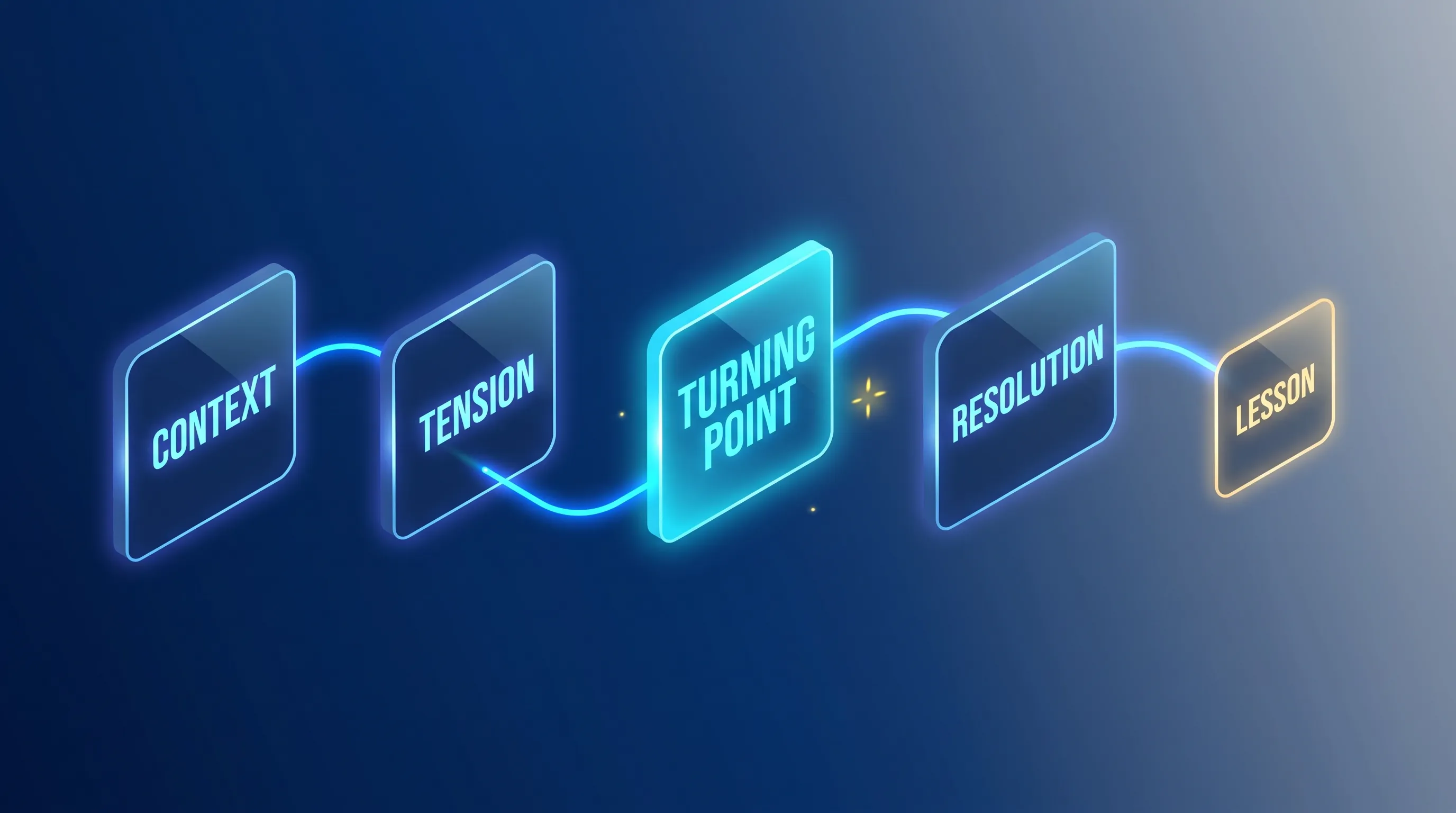
A story that works on LinkedIn almost always follows the same mechanics, in five short steps.
Context
One or two sentences to set the scene: who, where, when. No more, the context is not the story, it is the backdrop.
Tension
What is stuck, what is worrying, what is not resolved yet. Uncertainty is enough, no need to dramatize.
Turning point
The precise moment something changes: a decision made, a sentence overheard, a choice made under pressure.
Resolution
The outcome, honest and sometimes imperfect. An ending that is too perfect rings false and hurts credibility.
Lesson
The transferable takeaway the reader can apply to their own situation, in one or two sentences.
Tension does not need drama
A good LinkedIn story does not chase sensationalism. All it takes is for the reader not to know how it ends: a decision to make within a few hours, a number that will not add up, a client who hesitates. Uncertainty holds attention, not intensity.
Where to find stories when you feel you have nothing to tell
Most professionals think they have nothing to tell because they are looking for an extraordinary event. The best LinkedIn stories come from ordinary moments seen again with a bit of distance.
- A mistake that taught you something
- A result that surprised you, for better or worse
- A client objection you hear often
- Advice you first ignored
- A conversation that changed a decision
It is the same logic as finding LinkedIn post ideas: the material almost always exists, and it is rarely as scarce as it feels. Jotting down these triggers as they happen, in one line each, keeps you from staring at a blank page when it is time to write. Like industry monitoring, story material is collected continuously, not hunted for at the last minute.
Three narrative structures to test depending on the situation
The 5-step structure works in every case, but three variants help frame a story depending on what you want to demonstrate.
| Structure | When to use it | Outline |
|---|---|---|
| STAR | For a success or a concrete result | Situation, task, action, result |
| Before / After / Bridge | For a transformation or a change of method | Starting point, end point, what connects them |
| Problem / Agitation / Solution | For a post that leads to a tip or a tool | Pain identified, consequences if it lasts, answer provided |
These three structures are only variants of the same 5-step mechanics: they change the order in which elements appear, not their nature. Pick the one that best fits what you want the reader to remember.
An annotated storytelling post example
Here is a fictional example, built with the 5-step structure, to adapt to your own story rather than copy as is.
Example post (fictional)
Context. Last Tuesday, a client sent me a message at 11pm: "We're stopping everything."
Tension. The project we had been working on for three months, the one meant to double his online revenue, was about to stop dead, and I did not understand why.
Turning point. I called him the next morning instead of replying in writing. Within ten minutes, I understood the problem was not the project: he was afraid he would not know how to keep it running on his own once it was delivered.
Resolution. We changed the contract to include three months of support after delivery. The project goes on.
Lesson. A client who wants to stop does not always say what really worries them. A call costs ten minutes, a message can cost the project.
Notice how short each step is: the context fits in one sentence, and so does the lesson. That density is what lets a story fit in a 200 to 300-word post without feeling stretched.
Mistakes that break a LinkedIn story
- Too much context. The first three lines need to hook, not set the scene in detail.
- A story that is not yours. Readers sense the distance, even without proof.
- An ending that is too smooth. A perfect resolution with no rough edges sounds like an ad.
- Only successes. Alternating with owned failures builds more credibility than a string of wins.
- A diluted lesson. One sentence is enough; the reader should be able to remember it without rereading the post.
Tone matters as much as structure: a story frozen in overly formal language loses its effect, even when well built. How to write like you talk on LinkedIn without losing credibility explains how to keep a natural tone without sacrificing seriousness.
Frequently asked questions
A story triggers a narrative attention that lists of tips lack: the reader wants to know how it ends, and remembers the lesson because they saw it happen. A tips post passes on information, a story brings it to life.
Further reading

Key takeaways
A well-built storytelling post follows simple mechanics: short context, real tension, a clear turning point, an honest resolution and a transferable lesson. It is not a format reserved for great communicators: it is a repeatable structure you learn by applying it to your own anecdotes, even the most ordinary ones.


