B2B Content Marketing: The Complete Strategy for 2026
B2B Content Marketing: The Complete Strategy for 2026
A blog post every two weeks and a few scattered LinkedIn posts do not make a B2B content marketing strategy. Without a method, content piles up without ever turning visitors into prospects, and the marketing team ends up producing for the sake of producing. B2B content marketing is precisely about reversing that: every piece of content exists to answer a real buyer question, at the right moment in their thinking.
Here you will find a complete method to build that strategy: the steps to follow, the formats that work best in B2B, the central role of LinkedIn in the setup, and the mistakes that explain why so many content strategies run out of steam after three months.
What is B2B content marketing?
B2B content marketing means producing and distributing useful content to attract, inform and convert professional buyers, without relying on direct advertising. Unlike an ad campaign that sells immediately, content builds trust upstream and supports the prospect over several months, the length of a B2B sales cycle.
How B2B differs from B2C
Three differences shape the whole strategy:
- The decision cycle is long: several weeks to several months, with several decision-makers involved.
- The purchase looks rational, but the decision stays human: trust in a brand weighs almost as much as the numbers.
- Content has to convince several profiles at once: the end user, the budget holder and sometimes the technical team.
That last difference explains why a single article is never enough: you need a body of content that answers each profile, at each stage.
Why a real strategy changes everything
For a B2B SMB or startup, content is often the cheapest acquisition channel over time: unlike advertising, an article or post that ranks keeps generating traffic months after it is published. But that advantage only materializes if content is designed as a system, not as a series of isolated initiatives.
A clear strategy lets you do three things: prioritize (know which content to produce first), keep the pace (not depend on inspiration), and measure (know what actually generates prospects rather than views).
The steps to build your B2B content marketing strategy
Define your personas and their buying journey
List the 2 to 3 profiles involved in the purchase decision (user, budget holder, technical influencer) and their questions at each stage: what they want to understand before talking to a salesperson, then before signing.
Audit what you already have
List the content you have published over the past year: which pieces generate organic traffic, which generate prospects, which never found their audience. An honest audit often shows that a third of the content can be deleted or merged at no loss.
Set measurable goals
Each piece of content serves a specific goal: organic traffic, qualified prospects, awareness, or ranking on a strategic keyword. Avoid catch-all goals like "getting visibility", which can never be measured.
Map content to each funnel stage
Awareness (blog posts, LinkedIn posts), consideration (case studies, comparisons), decision (demos, free trials, testimonials). Each stage calls for a different format and tone.
Build a realistic editorial calendar
Two solid pieces a month kept up for a year beat an ambitious rhythm abandoned after six weeks. Consistency matters more than volume, both in Google search and in the LinkedIn algorithm.
Promote and measure
Content published without active promotion (LinkedIn, newsletter, repurposing) stays invisible. At a minimum, track organic traffic, the conversion rate to trial or demo, and the number of prospects attributable to each piece.
The B2B content formats that work best
| Format | Funnel stage | Role |
|---|---|---|
| SEO blog post | Awareness | Capture an informational search |
| LinkedIn post and carousel | Awareness | Build awareness and trust |
| Case study | Decision | Prove the result with a real customer |
| Tool comparison | Consideration | Support a choice already under way |
| Webinar or demo | Decision | Remove the last objections |
| Newsletter | Retention | Stay in touch after conversion |
Case studies remain one of the most popular formats at the decision stage, and the blog, often seen as less prestigious than a white paper, remains one of the most cost-effective formats over time (source: Semrush guide to B2B content marketing).
13×
more likely to see a positive ROI when prioritizing blogging
65%
of B2B marketers rank case studies among their top 3 formats
310M
LinkedIn members, including 63 million decision-makers
LinkedIn, the central channel of B2B content marketing
For a B2B audience, LinkedIn brings together both the decision-makers and the professional context that makes content credible. An article that is invisible on Google can still find its audience through a post that relays it, provided that post follows the ideal structure of a LinkedIn post (hook, body, ending) rather than a bare link shared without a hook.
LinkedIn plays three roles in a B2B content marketing strategy: relaying long-form blog content, building the authority of the company's leaders and experts through personal branding, and generating leads directly through comments and direct messages.
The mistakes that sink a B2B content strategy
Avoid
- Producing without a goal: content that serves neither SEO, nor awareness, nor conversion is a cost, not an investment.
- Ignoring distribution: spending almost all your time writing and almost none distributing reverses the ratio that actually works.
- Copying the B2C tone: creativity does not replace relevance for a busy professional buyer.
- Changing topic with every piece: without a consistent editorial line, no content becomes a reference.
- Giving up after three months: SEO and awareness are built over several months, not several weeks.
How to keep the pace without spending your days on it
The constraint most often cited by content leads and founders who run their own content is not a lack of ideas, it is the time needed to turn monitoring into publishable content. Following a dozen sources, extracting the relevant trends, then writing a post in your own style: each of these steps takes time, and the work quickly piles up behind the rest of an SMB's priorities.
That is the gap filled by an automated industry monitoring tool like Suma AI, which turns an article or video you spotted into a structured LinkedIn post in about thirty seconds, in the author's style. The time saved does not replace the strategy defined above: it simply makes it sustainable over time.
Checklist: launch your strategy in 30 days
- Week 1: personas, audit of existing content, goals.
- Week 2: funnel mapping and a list of the first ten topics.
- Week 3: editorial calendar and format mix.
- Week 4: publish the first two or three pieces and set up tracking.
Frequently asked questions
B2B content marketing targets a longer decision cycle involving several profiles (user, decision-maker, influencer), with content that has to convince each of them. B2C targets a faster and often individual decision.
Key takeaways
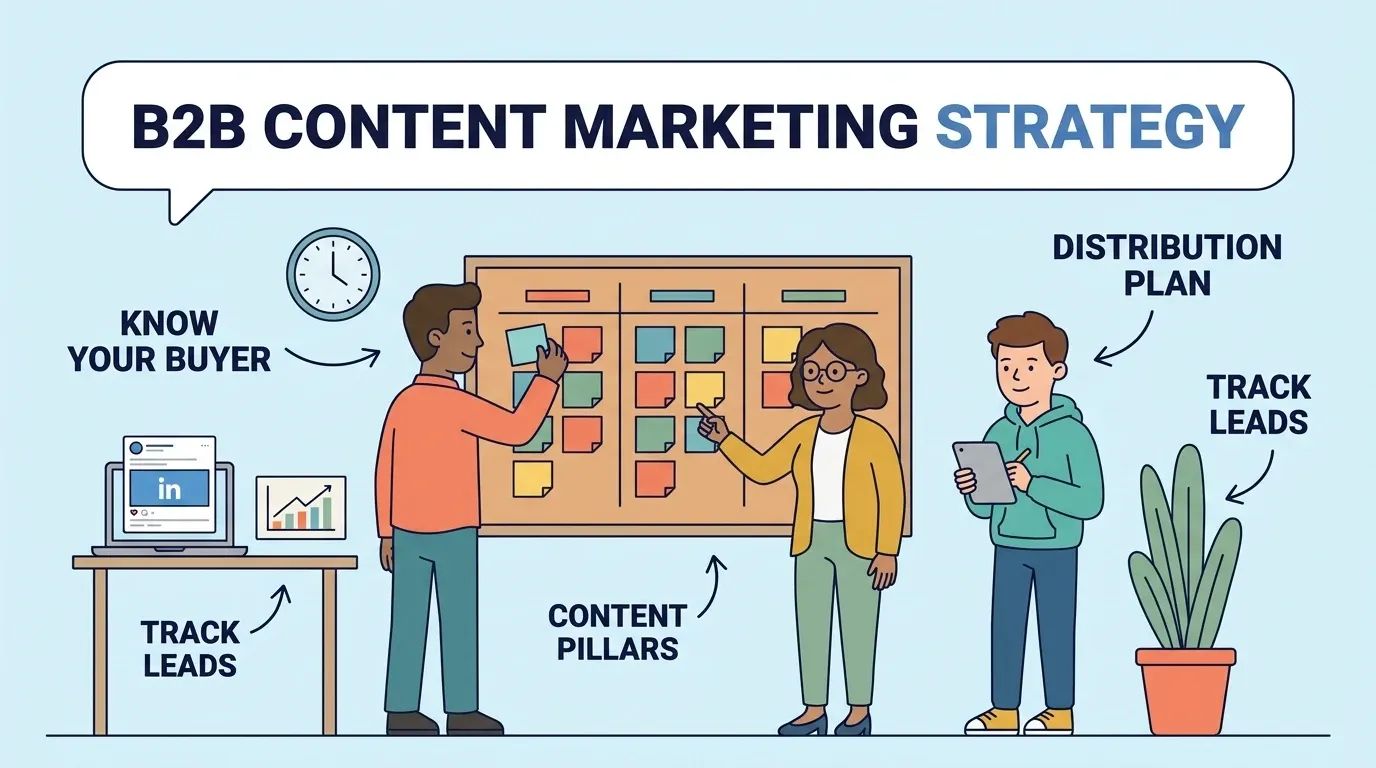
A B2B content marketing strategy that works rests on three pillars: a clear method (personas, funnel, calendar), formats suited to each stage of the decision, and a LinkedIn presence designed as a distribution channel in its own right, not as a box to tick.